Anglophone metaphysicians, and perhaps some other metaphysicians too, fairly recently started thinking about things in terms of ontological dependence. The idea is that some things depend on other things, or are grounded in those things; some facts are true in virtue of other facts, some things are fundamental while some things depend on the fundamental things, and so on. There’s a whole mess of concepts in the vicinity and we still haven’t sorted it all out, but it seemed like a useful way to think. It still does. I still think like that myself, sometimes.
One question you might ask about this framework is this:
Ross Cameron addressed this question in a paper a few years ago (Cameron 2008). He basically came to the conclusion that he couldn’t find anything incoherent about everything being grounded in something further down, but it’s an inelegant set-up and we should expect the world not to be like that. When I’ve come across people citing his paper it has mostly been to agree with his conclusion, although this impression may be unrepresentative or at least out of date. I like the paper too, and I’m pretty sympathetic to his take on the issue: metaphysical systems don’t have to be incoherent to be implausible.
Now, Cameron wasn’t the first person to think about this sort of thing. He mentions some predecessors in the paper, but today I’m going to talk about one he doesn’t mention. About a thousand years ago Avicenna was coming up with a proof of the existence of God, like you do, and his proof involved thinking about something structurally quite similar to the turtles question and coming to the opposite conclusion over whether there has to be something at the bottom. He thought the infinite descent scenario really was incoherent. Since one can count the people cleverer than Avicenna on the fingers of one hand, if he’s challenging our contemporary consensus we should probably take a look at what he had to say.
I’m not an Avicenna scholar, unfortunately. My knowledge of Avicenna comes mostly from a podcast by one Avicenna scholar (Adamson 2010-, especially #138-142) and a book by another (McGinnis 2010). I’ve also read a few passages from Avicenna’s own work in translation, including one on the argument I’m talking about here (McGinnis and Reisman 2007, especially pp214-5). It’s not nothing, but you probably won’t find me trying to turn this blogpost into a paper. (But if you’re an Avicenna scholar and think there’s something here worth tackling properly together, I’m not busy.) You might wonder why I’m writing about it at all, given my incompetence to do the topic justice; it’s basically because it seemed like there was something there and nobody else seemed to be writing about it. Maybe that’s because the medieval-philosophy-in-Arabic crowd and the contemporary-analytic-metaphysics crowd don’t overlap much. Anyway, if you think I’m talking rubbish but not such irredeemable rubbish as not to be worth engaging with, we can have a discussion in the comments or wherever and try to understand the issue better.
So, here’s Avicenna’s argument as I understand it.
He’s got a distinction between things which are necessary through (or in) themselves and things which are necessary through another. He’s not understanding necessity the same way philosophers do nowadays - possible worlds and all that - but I wouldn’t like to try to explain exactly how he is understanding it. It seems at least to be structurally a bit like something related to our contemporary concept of ontological dependence, though.
He thinks that everything is either one or the other, and nothing is both. In terms of ontological dependence, you can think about things that depend on something else, and things that don’t.
He wants to show that at least one thing must be necessary in itself. He’s going to go on to argue that various things follow from something being necessary in itself, and that there can only be one such thing, and he’s going to say that this necessary existent is God. But for the moment he just wants to show that there’s at least one.
We know that something exists. Look around yourself, look within yourself, whatever. Something exists.
Now gather everything together that is necessary through another. If there aren’t any such things, then since something exists, something must be necessary in itself. But if there are, then gather them together into one big object. (We should resist the temptation to call this object The Great Mumkin.)
Is this object necessary in itself, or through another? If it’s necessary in itself, then we’re done. If not, then what is it necessary through? (I’ve seen this step presented in different ways, and Avicenna may have presented it himself in different ways. He actually thinks it’d be absurd for the sum of all things necessary through another to be necessary in itself, but it’s worth noting that we don’t have to agree about that for his argument to work.)
If it’s necessary through a part of itself, that’s either absurd or counts as the part being necessary through itself. (I’m not really sure how this step goes, and it seems to me that it’s where most of the action is.)
If it’s necessary through something that isn’t part of it, then that thing must be necessary in itself, because everything else is a part of it.
So whichever option we go for, something is necessary in itself.
Now, I expect I’ve garbled the argument somewhere. The bit where we say that things can’t be necessary through a part of themselves seems especially dodgy. Here’s a worry: take the sum of everything that exists. Is that necessary in itself, or through another? If anything besides God exists, then it can’t be necessary in itself, at least according to Avicenna, because he` thinks only one thing is, and that thing is God and doesn’t have proper parts. But if it’s necessary through another, then that other thing must be a part of it, because everything is. But that’s not supposed to be allowed. So I don’t really get what’s going on there. (I guess he could say that in this case we choose the option at step 7 of the part being necessary in itself. But I do think I’m missing something here.)
One way of patching this is to say that everything is either necessary in itself, or is necessary through another, or is the sum of something necessary in itself and something necessary through another. (I’m using a pretty classical-mereology framework, because Avicenna seems to be. To call Avicenna a classical mereologist would be anachronistic by 900 years or so, but the argument helps itself to principles that are accepted by classical mereology but rejected in some non-classical mereologies. If classical mereology rules out turtles all the way down, that’s interesting in itself. Investigating which mereological principles are essential to the argument and which aren’t would be interesting too, and if the argument has something in it then it’s something we should do.) If we make this assumption, the argument still goes through much the same. You just include the mixed option in step six, and note that the mixed option also entails that something is necessary in itself. The sum of all things would be the sum of the Necessary Existent, which is necessary in itself, and Creation, which is necessary through another, viz. the Necessary Existent.
With different mereological assumptions you might also try constructing the sum-of-all-dependents object by removing everything necessary in itself and taking what’s left. That relies on a complementation principle you might want to reject (but which classical mereology accepts), but it’s worth noting the option. That object might not contain all dependents - if there’s a dependent object that is part of a necessary object, for example - but if it depends on something outside itself then something is outside it, and so something is necessary in itself because everything outside it is part of the sum of things necessary in themselves.
Anyway, let’s adapt Avicenna’s argument to the question of whether everything might be dependent on something else. We’ll call things that are dependent on something else dependent, and other things independent. We’ll allow mixed cases, and assume classical mereology (though not atomicity - there could be gunky things all of whose parts have proper parts).
Something exists.
If there are no dependent things, something is independent and we’re done. Otherwise take the sum of all dependent things.
If it’s independent or mixed, we’re done. So assume it’s dependent. What’s it dependent on?
If it’s dependent on something that isn’t part of it, that thing must be independent or mixed, and we’re done.
If it’s dependent on something that is part of it, that’s either absurd or counts as it being independent or mixed. (This is the dodgy step.)
In Cameron’s paper, he does sort of address a version of the summing-the-dependents objection, although not with particular reference to Avicenna. Let’s look at what he says:
Another potential justification for the intuition is familiar from the debate between Leibniz and Hume. Here, the thought is that if there could be an infinite chain of entities e1, e2, e3, ... such that e1 is ontologically dependent on e2, and e2 ontologically dependent on e3 etc, then, while every entity in the chain is grounded, nothing grounds the chain itself. Even if there needn’t be a first member of the chain – an independent entity that provides the ultimate ontological grounding for every member of the chain - there must be an ontologically independent entity to ground the existence of the chain itself.
But that’s unconvincing. Grant for the sake of argument that not only must every being on the chain have an ontological grounding but the chain itself must have an ontological grounding. This doesn’t entail that anything is an independent entity. Perhaps the chain of entities e1, e2, e3, ... depends on a further entity ea1 which depends on ea2, which depends on ea3 etc? And if someone asks “but what about the chain ea1, ea2, ea3...?” we can appeal to a new entity eb1 which is the ontological ground of this new chain, and which depends on eb2 which depends on eb3 etc. And so on. In each case, the infinite chain of entities is dependent on an entity which is itself the first member of another infinite chain. Provided we’re prepared to postulate more and more entities, one for every cardinal number, then nothing will go ungrounded. (Cameron 2008: 11)
I don’t think this works against Avicenna’s version of the objection. The problem is that mereology isn’t like set theory. (The reference to “one for every cardinal number” is talking about the way set theory deals with this kind of thing.) In set theory you can’t just gather all the things of a certain kind into a set and ask questions about it. You get Russell’s paradox and others if you allow that. But in mereology you can gather all the dependents together into a sum and ask questions about it. You don’t get the paradoxes, and in fact accepting unrestricted mereological composition is fairly popular among people who work on the topic. (The difference basically arises because the set of all Xs can’t have members that aren’t Xs, but the sum of all Xs can have parts that aren’t Xs. For example, the sum of all cars has parts that are wheels, not cars.) Since mereology allows this kind of comprehension principle, it doesn’t help to postulate more and more entities as Cameron suggests. Anything you postulate will either be part of the sum-of-all-dependents already or won’t be a dependent. There are issues about infinite extensibility and unrestricted quantification which might apply here, but our understanding of that is much less settled than our understanding of set theory, and moving from the difficulties of unrestricted quantification to the impossibility of unrestricted composition is a leap that would need some heavy-duty justification. I think it’s fair to say that in light of Avicenna’s version of the argument, Cameron hasn’t really said enough here to fend off the objection.
So I guess bringing Avicenna into the debate wasn’t a complete waste of time. But might there be something else wrong with Avicenna’s argument? The argument looks pretty solid, at least given the assumptions about mereology, except for the step at the end. Why shouldn’t an object be dependent on something that’s part of it? There are a couple of structures we can imagine as challenges to Avicenna’s picture.
Gunk: everything is dependent on its proper parts taken together, and everything has proper parts. So everything is dependent on something.
Turtles: reality is made of the earth sitting on top of an infinite descending series of turtles. Everything is dependent on the sum of the things its parts depend on, and everything is dependent on any segment of the series unbounded below and wholly strictly lower than it, if any. So the earth is dependent on the sum of the turtles, the top turtle is dependent on the sum of the other turtles, and the whole of reality is dependent on the sum of the turtles but not on itself (since nothing depends on the earth), and the sum of the turtles is dependent on the sum of the turtles other than the top one. (There are some issues to go into about overdetermination, joint dependence and so on, but I think it should be possible to fill in these details in this general picture.)
That wasn’t so hard. What was Avicenna thinking? Three possibilities come to mind:
He had a notion of necessity-in-itself which rules out these structures.
He had a notion which doesn’t rule out these structures but he didn’t think of them.
He had a notion which doesn’t rule out these structures but had other substantive commitments that do.
All are prima facie plausible, though the second is uncharitable. Avicenna scholars will have views, but I’m not in a position to say what those views would be. But we can still think about how we should respond to these cases.
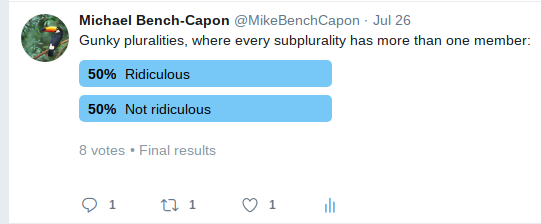
It’s worth taking the gunk and turtle cases separately. With gunk I think the best thing to do is just admit defeat if we’re allowing that things can depend on their proper parts. I think composition is identity, and things don’t depend on their parts: things are their parts. (Gunk is a bit weird if composition is identity, but I don’t see that it’s incoherent. Indeed, I don’t see that you couldn’t have gunky pluralities even if composition isn’t identity. Regular readers will be familiar with gunky pluralities from the previous post.) If you don’t think composition is identity - and if you’ve worked in the area then you probably don’t - then you might adopt some other substantive commitment linking mereology and dependence, like saying if an object depends on a part of x it depends on x, and so if things depended on their parts they would depend on themselves, which tends not to be allowed. But if you think things can depend on their parts, I guess you’re welcome to think the gunk example undermines the Avicennan argument. (And Avicenna does seem to think things depend in some way on their proper parts, which is part of why the necessary existent can’t have proper parts. I definitely feel like I’m missing something.)
With Turtles and Simple Turtles there isn’t really a ready-made metaphysical thesis like composition as identity that I can wheel out to undermine the argument. So what can we say? Well, I don’t have a great answer, but I do think that even being able to ask the question moves the debate forward a bit in terms of where you can apply pressure. The problem Cameron had with turtles all the way down was that it’s theoretically uneconomical: you can’t have one base explaining everything, because the base needs a separate explanation, and so on forever. It’s inelegant. But now we have a different objection: Turtles isn’t just inelegant; it’s weird. And where there’s weirdness, there might be Rationally Compelling Metaphysically Necessary Principles to rule it out. If you can think of one, feel free to put it in the comments.
References:
Adamson, Peter (2010-present): The History of Philosophy Without Any Gaps. Podcast. Historyofphilosophy.net.
Cameron, Ross P. (2008). Turtles all the way down: Regress, priority and fundamentality. Philosophical Quarterly 58 (230):1-14.
McGinnis, Jon (2010). Avicenna. Oxford University Press.
McGinnis, Jon & Reisman, David C. (eds.) (2007). Classical Arabic Philosophy: An Anthology of Sources. Hackett.