Pages

Showing posts with label politics. Show all posts

Monday, May 1, 2017

The After Dinner Circuit

It was recently reported that Barack Obama is getting paid $400,000 to give a speech to a Wall Street bank. Obama’s a great speaker, but a lot of people seem to think nobody’s $400,000 great, and so the transaction smacks of corruption. The thinking is that the bank must be getting more than just a speech for their money.


Now, I don’t know if it’s true that the speech alone isn’t worth that much to the bank. There’s a lot of money flying around in banking, and the stakes are high. Maybe if people come to your dinner rather than your competitor’s dinner, you might get a big deal that makes the money back. Or maybe hosting dinners with Obama attracts employees that could otherwise only be attracted with those enormous banker’s bonuses that we love reading about.


But let’s suppose that the speech isn’t worth that much to the bank, and they’re getting something else. Or maybe it is worth it to them but they're still getting something else, because that's how the after dinner speech market works. One possibility is that Obama made a shady deal where he did the bank some kind of regulatory favour while he was in office, on the understanding that they would pay him $400,000, which they are now laundering as a speaking fee. I think that's unlikely, but it’s beyond the scope of this blogpost to persuade you to agree with me that it's unlikely.


What I think is much more likely is that there’s a general understanding that Wall Street banks, and other big businesses, are willing to pay massive speaking fees to politicians after they leave office, and that they offer the gigs to politicians who are friendly to Wall Street and so on while they’re in office, and that on some level this influences the way politicians govern. This kind of thing is insidious and I can see it affecting basically everyone to some extent, without anyone doing anything they could be prosecuted for. That’s not ideal.


What can we do about this? One thing we could do is demand that politicians declare future conflicts of interest. If you’re taking a gig in the medium-to-near future that would constitute a conflict of interest if you had it now, then you need to declare it as if you had it now. I don’t see that it makes sense to have laws or strong norms about present conflicts of interest while relying on the honour system for future conflicts of interest. But let’s assume that’s not going to happen. What can individuals do?


Some people think Obama shouldn’t take this kind of gig. He should set an example, he needs to go high where other people go low, and so on. Even if his governing wasn’t influenced by the prospect of lucrative speaking gigs, he needs to extinguish any suspicion that it was.


Some other people think Obama should take the money. Everyone takes the money, and it’s unfair to demand he make all the sacrifices, especially when the new president brazenly doesn’t care about all his own conflicts of interest and spends government money at his own businesses all the time.


Here’s what I think. It’s too late for Obama. Whatever influence the speaking fees had on his presidency, they’ve had it already. We know he wasn’t planning to eschew the speaking fees, and changing his mind now won’t change whatever decisions he took during his presidency. If he was running for future office, things would be different. But he probably isn’t, and so it’s too late. Obama showed a lot of things were possible, but he can’t show that saving politics from the after dinner circuit is possible. And if he had been planning to do this, regulating Wall Street on the merits and to hell with the speaking fees, then he should have said something about it sooner. Like, when he was in office, or even before that.


It’s not too late for everyone. If you’re in office now, or you’re running for office in the future, and you don’t want politicians to be influenced by the prospect of future speaking fees, pledge not to take them. Or if you aren’t willing to go that far, then at least pledge not to take the really big fees. It’s simple, it’s easy for people to understand, and it doesn’t rely on backwards causation.


Sunday, February 26, 2017

The Bleak Future Of Boycotts

You’ve probably been there yourself. I know I have. A news story comes out about a company doing some nefarious thing and you decide to express your dissatisfaction by boycotting them. When I was a kid there was something about Nestlé and baby milk, and I suddenly found out just how many things are made by Nestlé. Every so often there’s one about McDonald’s, and more recently there have been boycott-inducing stories about Uber and Byron Burgers. I don’t know whether it achieves what it’s supposed to achieve. I joined in with the Byron Burgers thing, and I didn’t have to decide about the Uber one because I don’t have a smartphone.

It seems like a good idea in principle. A company does something you disapprove of, and you try to stop them doing it by withholding your custom. Or maybe you’re not trying to change their behaviour but you just don’t want to give these ne’erdowells the benefit of your custom, even if it means forgoing their products and services. Cutting off one’s nose to spite someone else’s face makes a certain amount of sense.

Lately I’ve noticed some boycotts being encouraged to protest more mainstream associations like Donald Trump and the Daily Mail. The idea is that if you don’t like Trump then you boycott companies run by people that do, and if you don’t like the Daily Mail then you boycott companies that advertise in the Mail.

In principle this doesn’t make any less sense than using boycotts to protest less controversially awful things. If you think advertising in the Daily Mail is as bad as whatever Nestlé and Byron Burgers did, then it doesn’t really matter that lots of people think the Daily Mail is great. But I worry about where it leads.

It seems to be the received wisdom that politics, at least in America, is becoming more polarized and tribal. If members of one tribe boycott a lot of the companies belonging to the other, the way they already kind of do with media outlets, then you’ll end up with two parallel economies. That’s bad for competition, presumably, but it also might lead to governments from one tribe punishing companies from the other. That sounds bad. I hope it doesn’t happen.

Sunday, February 5, 2017

Parliament's Role In Brexit


Governments plan for some pretty unlikely things. They plan for pandemics, nuclear wars, conventional wars, natural disasters, the sudden deaths of leaders, and all sorts of other things. For some of these, nuclear war for example, planning for them plausibly makes them less likely. But whether or not planning for something makes it less likely, it’s good to plan. It’s become fairly clear that the British government didn’t have much of a plan for what to do if we voted to leave the EU in the referendum last June. The polls were pretty close beforehand and there was a significant chance we’d vote to leave, so I think not having a plan was pretty irresponsible. But here we are.

I voted to stay in the EU, and it wasn’t a difficult decision for me. I’ve been strongly in favour of the UK remaining in the EU for a long time. Regular readers of this blog may have picked up on that already. It also seems that most MPs wanted to stay in the EU too, or at least they used to say they did. It’s unclear whether Theresa May and Jeremy Corbyn were sincere in the their support of remaining in the EU before the referendum, but the received wisdom is that, like capital punishment, leaving the EU is one of those things that’s more popular with the general public than with MPs. I don’t really want to make the case that leaving the EU was a bad idea here, though, or even to debate the wisdom of holding the referendum in the first place. I want to talk about how MPs should have responded to the Leave vote.

Essentially, I think they should have treated it like any other unexpected event that they didn’t have a plan for and which most of them didn’t want. Like an asteroid heading for the Earth, or a pandemic, or the Royal family all dying in a plane crash, assuming they didn’t have a plan for those things.

One thing to decide is who’s in charge. It turns out we didn’t know who was in charge, but the courts decided that Parliament was at least partly in charge, because leaving the EU would involve changing laws and the executive isn’t allowed to do that by itself. The courts ruled that we couldn’t leave the EU without Parliament voting for it.

Another thing to decide is what kind of deadline we’re working to. When a country triggers Article 50 of the Lisbon Treaty, they’ve got two years to negotiate an arrangement with the rest of the EU and after those two years they’re out. The original referendum bill could have authorized or even required the executive to activate Article 50 immediately or within a specific timeframe after a Leave vote, but it didn’t. David Cameron might have tried activating it anyway just after the vote, but he didn’t. He resigned and left the problem to other people. Basically the answer is that there’s no firm deadline until Parliament votes to start the clock. Presumably waiting for too long would be a bit cheeky, but there’s no fixed deadline for them. That’s lucky, because it gives them time to come up with a plan, which, as we’ve said, they didn’t already have.

The Government does seem to have some kind of plan now. It’s basically what people call “hard Brexit”: we leave the EU and the single market, and where this leaves gaps in our relationships with other countries we renegotiate them more or less from scratch. That’s not what all the Leave campaigners wanted: a lot wanted to stay in the single market. But hard Brexit seems to be the Government’s preferred option. They haven’t said whether they plan to forcibly relocate the three million EU nationals living in the UK, possibly because they want to use this as a bargaining chip in the negotiations. Maybe some MPs (and peers) would prefer to be like Norway or Switzerland, or would at least like to commit to not doing the forced relocations. If they do, they’re in luck! The executive can’t leave the EU without a vote, and Parliament can withhold the vote until the executive agrees to a plan Parliament is happy with. They can put the conditions into the law they vote for too, if they like. They could even refuse to leave the EU at all, overruling the will of the people for what they believe to be the good of the people. That would presumably undermine the public’s faith in our democratic processes somewhat, but democracies have survived worse. Parliament is sovereign and if they really think any kind of Brexit would be worse than letting democracy take the hit, then they’ve got that option.

So here’s what I think Parliament should do. They should take their time and debate the issue properly until they’ve come up with a plan they’re happy with. That plan will probably involve leaving the EU, because of the referendum result. If they’d had a plan before the referendum, the process would have been quicker. (And if they’d told us what it was, we might have voted differently. See the earlier comment about planning for nuclear war making nuclear war less likely.) They didn’t have a plan, and that’s on them, but we are where we are and they have plenty of time to debate it and come up with something not totally awful.

But it seems that’s not how it’ll go. MPs are voting on Wednesday to let the Government do its hard Brexit, and the House of Lords is expected to acquiesce as well. MPs aren’t happy with the plan, and they’ll debate some amendments, but when the amendments are defeated they’ll vote for the unamended bill that they don’t support, because they’re cowards and they don’t understand the situation they’re in and the responsibility they have. The public has no say in what kind of Brexit we do, and Parliament is giving up its say. Taking Back Control is not getting off to a good start.

Monday, December 19, 2016

The Electoral College Is A Good Idea

As I write this, the American electoral college is voting for the President. They are probably going to elect Donald Trump. America is unusual among democracies, in that its President is not elected directly. The simplest system, and the one most countries with presidents use, would be to award the Presidency to the person who gets the most votes. Then they could say that the President had a democratic mandate, the choice reflected the will of the majority, and that sort of thing. But they don't do that.


Each state (and DC) appoints some electors to the electoral college, and the electoral college elects the President and the Vice President. A state gets a number of electors equal to the number of representatives it has in Congress, and DC gets three, which is the number a state with DC's population would have. States have a number of House members proportional to their population, and two senators. This means, for the most part, that the smaller a state (or DC, although there are additional complications with DC) is, the more electors it has per person. If no candidate gets a majority of the votes then the House of Representives votes from among the top three.


Forty-eight states, and DC, tell all their electors to vote for whichever President/Vice President ticket got the most votes in the general election. Maine and Nebraska tell one elector to vote the way each electoral district voted, and tell the other two electors to vote for whichever ticket got the most votes statewide.


Some people - perhaps most people - don't think this system is very fair. These people are wrong.


There are four main objections to this system:

1) Small states have an influence in the electoral college out of proportion to their populations.
2) The system allows for the candidate who gets most votes not to become President. This happened to Al Gore in 2000, and to some other people a long time ago, and it will probably happen again to Hillary Clinton this year. It happened with the Vice Presidency too, to Joe Lieberman in 2000 and probably to Tim Kaine this year, but nobody cares about that.
3) When a state heavily favours one candidate, neither candidate has to do anything to get that state's votes, since one is guaranteed to get no electoral votes anyway and the other is guaranteed to get all of them.
4) If the electors don't vote the way they are told, then the wrong person will become President (or Vice President). This has never happened before, unless it's happened this year while I'm writing, but it bothers people that it could happen.


The first three can be taken together, because the correct response to them is the same. There's a big difference between a state of America and an administrative division of a lot of other countries.


In Britain, where I live, the national government is in charge. We have some devolution in Scotland, Northern Ireland, to a lesser extent Wales, and to a still lesser extent London, and they're a bit more like states. But in England the national government is in charge. It divides the country up into electoral regions, counties, metropolitan boroughs, postal regions and so on, at its convenience. Some of these regions have elections and local governments. But the national government divides it up however it wants. If the government wants to move most of Wirral, where I grew up, from Cheshire to Merseyside, then it does. (People write to local papers saying that Wirral is all still in Cheshire, but they are wrong.)


States are different. The original states of America were independent entities that decided to form a union, with a federal government controlling some things, and the states retaining control over some other things. It's a bit like the European Union. The central governing entities of the EU can't just decide that Wirral is a part of Ireland now, or that Alsace and Lorraine are parts of Germany. They can't tell countries how to appoint their commissioners. And there are some things they can't regulate within the countries, without an amendment to the European Union's rules that could be vetoed by any of the member countries.


To summarize: most countries divide themselves into administrative regions, but the states organize themselves into a country.


States aren't as independent as member countries of the European Union, but that's because they've chosen not to be. There are some rights they haven't chosen to give up, and one of those rights is the right to tell their electors who to vote for when it comes to the Presidency and the Vice Presidency. Now, maybe you think the states should give up this right, or that the states should decide how to tell the electors to vote in a different way. But that's up to them, and all the states have democratically elected governments that can change it if they want.


OK, now we can take the objections in turn.


1) Small states have an influence in the electoral college out of proportion to their populations.


Without loss of generality, California (big population) has made a deal with Montana (small population). The deal says that California has more influence over the Presidency than Montana, but not in proportion to the population. It's the same deal they've made when it comes to representation in Congress. If California doesn't like the deal, they can try to renegotiate the deal. They can't unilaterally secede, but nor can Montana: that's part of the deal too. But if they're renegotiating the deal, secession could be on the table. It's understandable that Montana doesn't want to be a drop in someone else's bucket, any more than Malta wants to be a drop in Italy or Tunisia's bucket, and it's understandable that other states are willing to compromise on this to get the benefits of having them in the Union. And whether or not you agree that it's understandable, that's the deal they made.


2) The system allows for the candidate who gets most votes not to become President.


Accepting (1) means accepting (2).


3) When a state heavily favours one candidate, neither candidate has to do anything to get that state's votes.


Most of the states, in the infinite wisdom of their state governments, have decided to tell their electors to vote for whoever gets the majority of votes in that state. This means that the presidential candidates can more or less ignore the interests of people in, for example, California (which always votes Democratic) and Texas (which always votes Republican). They can't afford to ignore them in the primaries, but once they've got the party's nomination, it's all about Florida and Ohio.


It's understandable that swing states would go for winner-takes-all. The presidential candidates can be expected to promise extra goodies to voters in swing states, which benefits everyone there. And while there's a chance the whole state won't vote the way an individual voter or legislator likes, this is kind of balanced out by the possibility that the whole state will vote the way they do like. The expected number of electoral voters isn't necessarily the same, because the expected vote split isn't the same as the chances of each side winning. (Suppose the state was guaranteed to vote 48-52.) Swing states aren't necessarily close states; they're states where either side might win (which in practice tend to be close states). But in genuine swing states, it's a gamble to be winner-take-all but not obviously a bad gamble, and there is the added bonus of candidates paying more attention to the voters when setting out their platforms.


It's less obvious that voters in safe states should prefer winner-take-all. They confine their influence over candidate platforms to the primaries, and in return they get a bigger influence in the electoral college. (Or for the minority voters, no influence. A California Republican or a Texas Democrat shouldn't prefer winner-take-all.) Most states have gone for winner-take-all. This is the outcome of a standard democratic process within the states themselves. Call it tyranny of the majority, but the states are representative democracies and not direct democracies, so if the voters care enough about it, there will be votes in it. I guess they care about something else more, and let the majority have their way on this one. In a democracy, the minority has to pick its battles.


4) If the electors don't vote the way they are told, then the wrong person will become President.


For some people, this is the one thing about the Electoral College they like. If someone wins the general election but they would be such a disastrous President that it's worth violating a strong democratic norm to keep them out of the White House, there's a final line of defence. But most people probably think that this norm is important enough that it should be enforced by a law. Some states do enforce it with a law, but the penalties probably aren't a sufficient deterrent given the stakes.


I'm not going to say whether this feature of the Electoral College is a bad thing or a good thing. Unlike the other three objections, it's less clear cut. But it's worth pointing out three things. First, the norm has proven pretty strong. Its being a norm rather than a law hasn't changed the result of any elections. Second, it's not weird to have the top dog chosen by representatives chosen by the people. Britain does the same thing. (Unless you think the Queen is top dog rather than the Prime Minister, but the Queen isn't directly elected either.) Third, if a few electors did violate the norm and cause a crisis, the (democratically elected) House of Representatives would usually be able to step in and avert that crisis. They would only be unable to avert it if someone who got a majority of pledged electors didn't get in the top three of actual electors, or if no-one got a majority of pledged electors and one of the top three pledged didn't get in the top three actual. [BUT SEE UPDATE BELOW.] Given the two party system and the strong norm, neither situation is likely. It's a bit more likely that a close electoral college would go to the House and the House would pick the wrong person. But it's OK if your constitution would lead to a minor constitutional crisis in an unlikely situation and a major constitutional crisis in a very unlikely situation. It's normal. Everyone's constitution is like that. You can't blame the electoral college.


Obviously I don't actually think the electoral college is a good system; nobody does. But it’s fun to defend the indefensible, and debate's healthy.

UPDATE 15/02/18: I've realized that the House would also be unable to avert the crisis if someone got a majority of actual electors without having had a majority of pledged electors. I guess this is more likely than the other two situations I thought of: you'd get it when the pledged elector count was very close and a small number of electors defected. I'm not sure how much this possibility should affect the strength of the overall argument.

Wednesday, October 26, 2016

Let's talk about national insurance

Most people think rich people should pay more tax than poor people. There are at least three reasons for this. First, governments have to get their money from somewhere, and if everyone paid what poor people are able to pay, there might not be enough to run the government. Second, a given tax bill will do more damage to a poor person’s standard of living than to a rich person’s, so you can minimize the damage by having poor people pay less. Third, some people think it’s fair for rich people to pay more.

There are several ways of having rich people pay more tax. We tend to do this by taxing people more if they have higher incomes, although income and wealth aren’t the same thing. Taxing income instead of wealth doesn't really make sense to me, but maybe it's because it’s easier for rich people to avoid wealth taxes. But there are also different ways of taxing higher incomes more.

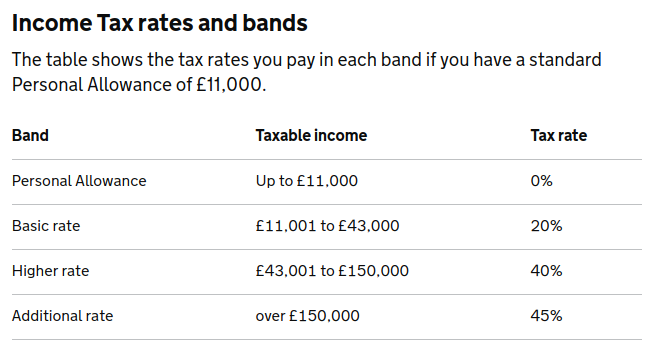
You can have a flat tax, so people pay in proportion to their income. 20% of a million pounds is more than 20% of ten thousand pounds. But that’s not what countries normally do. Normally they have what’s called a progressive tax. A progressive income tax is one where people with higher incomes pay a higher proportion of their incomes. The income tax in the UK is a progressive tax. Here are the rates:


UK Income Tax bands.png

You don’t pay any tax on the first £11,000 of yearly income, and then you pay 20% of the next £32,000, 40% of the next £107,000, and 45% of anything after that. People with higher incomes are paying higher rates. People making under £11,000 aren’t paying any income tax at all.

A progressive income tax has the “rich people pay more” effect to a greater extent than a flat tax does, and so leftwing people tend to like progressive taxes. Leftwing people these days also often call themselves “progressives”. As far as I know, this is a coincidence.

Now, as well as a flat tax or a progressive tax, there’s also the theoretical option of a regressive tax. You could just reverse the numbers in the table above: people pay 45% of the first £11,000, 40% of the next £32,000, 20% of the next £107,000, and nothing on income after that. Rich people are still paying more, just to a lesser extent. (Well, very rich people are all paying the same if the top rate is 0%. But very poor people are all paying the same, i.e. nothing, under the existing set-up. It still counts as rich people paying more than poor people.)

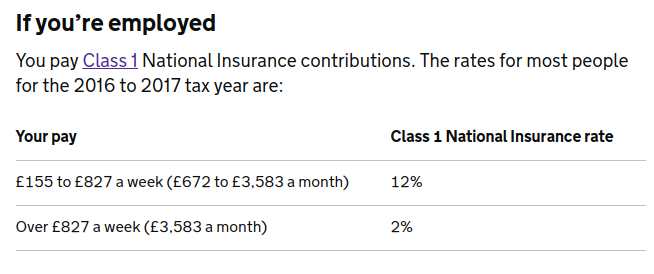
A regressive tax would probably be pretty unpopular. People would think it wasn’t fair, and to raise enough money to run the government you’d have to collect a lot of money from poor people, with inevitable damage to their quality of life. So it might surprise you to hear that the UK - the very same country that has the rather progressive income tax we talked about earlier - also has a very regressive tax. It’s called National Insurance. It doesn’t have the word “tax” in its name, but it’s still a tax. Here are the rates for employed people:

National Insurance marginal rates.png

Eagle-eyed readers will have noticed that £155 a week is a lot less than £11,000 a year, so while the poorest workers aren’t paying any income tax, they’re still paying plenty of national insurance. £827 a week does also put you more or less on the cusp of the basic and higher rates of income tax, which I suppose counts for something. But the fact remains that the UK has a progressive income tax which politicians and journalists talk about a lot, but makes up for it with a regressive tax that they hardly talk about at all. I don’t know if other countries do this, but it certainly seems odd. It’s hard to see what ideology a government could have which would motivate levying both taxes.

Before the 2015 general election, David Cameron said he had raised the personal income tax allowance a lot. “That is three million people taken out of income tax altogether”, he said. And I suppose that technically it was, but they were still paying plenty of tax on their income and their marginal rate was still 12%. So what Cameron said was a little bit misleading.

I think it’s very likely that the reason we have a progressive income tax and a regressive employment-income tax to make up for it is because the government and the electorate don’t agree on how progressively they want income to be taxed, and so the government divides the tax into two and mostly talks about the one that sounds less nakedly plutocratic. Maybe that’s not why they do it, but I’d at least like an explanation.


Monday, July 18, 2016

Cocksure certainties

I was reading an opinion piece in the Observer by Nick Cohen yesterday, and I came across this paragraph:


As the opposition collapsed last week, Paul Mason insisted that Labour must be transformed from a party that seeks to govern into a “social movement”. Mason, along with Michael Gove, Boris Johnson and Milne, is part of a group of journalists who have poisoned public life by taking braggart swagger and cocksure certainties of newspaper punditry into politics. But in this instance, he was authentically reflecting “the people” or, rather, that tiny section of “the people” who pay £3 and click on a link to show they agree with him.


My first thought was that it was strange for a political newspaper pundit to talk about political newspaper punditry in such uncharitable terms. It might be fair enough for a reality TV star to criticize Donald Trump for poisoning public life by taking the cartoonish offensiveness and fakery of reality TV into politics, but this seems different. Political newspaper punditry seems too similar to public life for braggart swagger and cocksure certainties to be OK in one but not in the other. Perhaps you’ll disagree with me about that. But there’s something else I wanted to pick up on in the paragraph. It’s the cocksure certainty expressed with such braggart swagger in the last sentence. I think it might not be quite accurate.


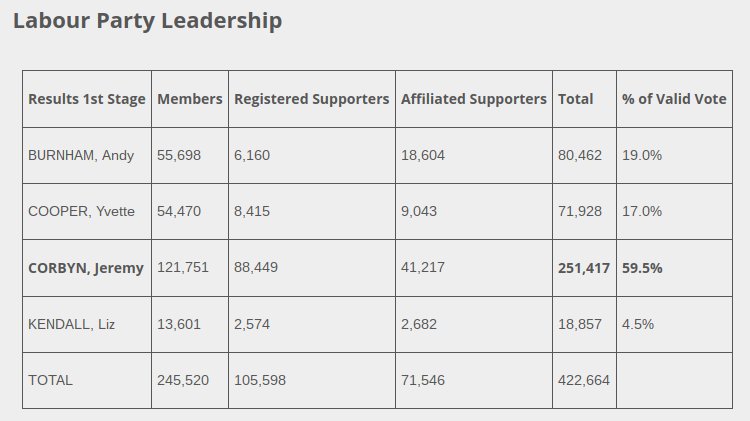
Corbyn labour leadership results.jpg


You’ll notice that Corbyn did much better than any of the other candidates among members, and among registered supporters, and among affiliated supporters. From what Cohen said, you’d think that Corbyn won the election because of the votes of the people who had paid £3 to be able to vote in the leadership election. Those people are the “registered supporters” column. But if Corbyn is winning in all the columns, then what Cohen said is quite misleading. Unless I’ve misread something.


I don’t know if he really thinks Corbyn won the election on the back of the £3 voters. It seems a weird thing for him to be wrong about. But since people are discussing Corbyn’s leadership a lot at the moment, it’s worth getting this right. When Corbyn was elected, the big split wasn’t between the party and the clicktivists. It was between the party membership, the clicktivists and the members of affiliated organizations on the one hand, and the Labour MPs on the other. Maybe the split is in a different place now, but that’s where it was last year.

Now, I understand that Nick Cohen thinks that the platform that most Labour MPs want the Labour party to present is closer to the views of the electorate as a whole than Corbyn's platform is. That's a genuine concern. But it's very different from the idea that Labour's leadership is out of touch because the election was hijacked by a group of fairweather enthusiasts with £3 to spare. If Labour is out of touch with the people, then it's out of touch at every level but the MPs. (The MPs may of course be out of touch as well. We don't really know a great deal about the people's view on Angela Eagle, Owen Smith, or whoever the Parliamentary Labour Party wants to replace Corbyn with.)

***************************

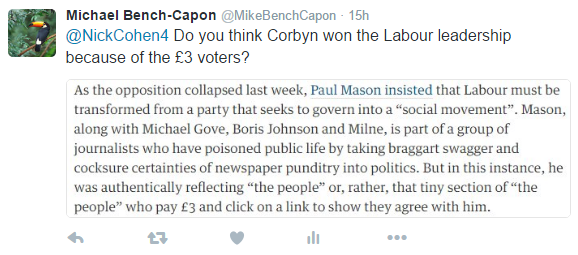
I did try asking him on Twitter whether he thinks that Corbyn only won because of the £3 voters, but he didn’t reply. That’s completely understandable: he’s famous and I’m sure people tweet at him all the time. Here’s the tweet:


Tweet to Nick Cohen about Corbyn and £3 voters.png


Wednesday, July 6, 2016

Negotiating styles

In Britain, where I live, we’ve been having a bit of a political crisis over the last week and a half. We went and voted to leave the European Union, and now we have to decide how exactly that’s going to work. One of the things we have to decide is what’s going to happen to all the citizens of other EU countries who live in Britain at the moment. As Britain is an EU country too, they’re currently allowed to live here. Once we leave, they won’t automatically be allowed.


Now, we could just let them stay, if we wanted to, but we haven’t committed to that yet. Apparently when we’re negotiating our new relationship with the EU, deporting them will be on the table. And you might think that’s just good sense - the other EU members will want to look out for their citizens’ interests, and that means negotiating an arrangement on which they won’t have their lives turned upside down by being deported. Committing ourselves now would reduce our negotiating power.


But don’t we want them to stay? They contribute to life here, and deportation is awful, so kicking them out would be lose-lose. These people are our friends and neighbours, and deporting people is neither friendly nor neighbourly. But the possibility that we don’t want them to stay shouldn’t be ruled out. The person making this decision is quite likely to be Theresa May, and gratuitously deporting people is one of her hobbies. And then there are all the people in Britain who just don’t like immigrants. Without those people we never would have voted to leave the EU in the first place. So maybe that’s what’s going on.


But perhaps we really do want them to stay, but we’re pretending to be willing to do mass deportations as part of a negotiating strategy. If the other EU members don’t call our bluff, we might get some concessions out of them. It’s like threatening to walk away from the table. You don’t want to walk away from the table, but if the other side thinks you might do it anyway then you have more bargaining power.


This isn’t like walking away from the table, though. What happens if you don’t come to a deal? You do what you can to get what you wanted by yourself. And since we don’t need EU members’ co-operation to let their citizens stay here, in the absence of a deal we would just let them stay, if that’s what we wanted. Threatening to deport them, even though we don’t want to, is therefore not like threatening to walk away from the table. So what is it like?

It’s like threatening to kill hostages. People don’t tend to particularly want to kill their hostages, but they threaten to do it because they think people won’t dare call their bluff. This negotiating tactic can work, of course, both in real hostage situations and in the iterated prisoner’s dilemma of international diplomacy. But however effective it is, it’s not the negotiating tactic of civilized businesspeople. It’s the negotiating tactic of Bond villains, and I don’t want people negotiating on my behalf to use it.

Saturday, March 12, 2016

Why Trump's opponents endorse him over Clinton

I’ve been following the US Presidential primaries fairly closely, partly because it’s important and partly because a lot of the coverage comes in the form of comedy monologues from late night shows I can watch on Youtube. I haven’t contributed much to the coverage myself, and up to now it’s been getting by fine without me. But now I think I may have thought of something new to say about it. I've seen some people wondering why Cruz, Kasich and Rubio still say they’ll endorse Trump if he wins the nomination, and I think I know the answer.


Here are four possible explanations which I don't think are right. First, they actually think Trump would be a better President than Hillary Clinton. It’s hard to get into the head of someone who thinks that, but these aren’t especially normal people we’re talking about, so maybe that’s what’s going on. A second possible reason is that they said they would support whoever was nominated. Politicians don’t like to be seen to break their promises, and maybe they don’t want to be seen to break this one, at least not while they’re still running for President. A third alternative is that they respect the democratic processes of their party. Cruz, Kasich and Rubio are all members of the Republican party, and might be presumed to have some party loyalty, and that includes loyalty to the primary voters. If the voters endorse Trump, they’ll endorse Trump out of loyalty to the voters. Fourth, they may be concerned that Republican primary voters think Trump would be a better President than Hillary Clinton. Lots of these people are actually voting for Trump, after all, and they made up their minds a long time ago that Clinton would be a terrible President. Maybe the candidates think that endorsing Clinton over Trump would turn voters off.


I don’t think any of these are especially implausible, but they’re not very clear-cut. You can imagine the candidates or their campaign strategists thinking quite hard about the decision, analysing polls and asking themselves fundamental questions about who they really are as politicians, and they could end up going either way. Three fairly different candidates in fairly different situations have all considered the question and all come up with the same answer: say they’ll endorse Trump if he wins. One exaplanation for the consensus is that the question is in fact a no-brainer. And I think it is.


Trump agreed he would endorse the eventual nominee and not run as a third-party candidate as long as the party was fair to him. Cruz, Kasich and Rubio all just pledged their loyalty without the fairness caveat. If Cruz says that actually he won’t endorse the eventual nominee if it’s Trump, and then Cruz wins the nomination, the agreement with Trump will clearly be broken, and not by Trump. Trump would be free to run as a third-party candidate, and why wouldn’t he? He’s rich, he’s having the time of his life, and he might even think he could win. So Trump runs, he and Cruz split the rightwing vote and Clinton wins in a landslide. In short, Cruz, Kasich and Rubio are sticking to their agreement because not doing so would doom any chance they have of winning the Presidency.

Of course, this reason for endorsing Trump over Clinton disappears when a candidate drops out of the race or if Trump actually wins the nomination. It’s unlikely he’s going to stop giving Republicans pretexts for saying that this time he’s gone too far and even Clinton would be better. It’ll be interesting to see if they’re still endorsing him in November.

Wednesday, September 7, 2011

How can this possibly be legal?

One of the measures which is standardly used to prevent corruption is making people in positions of power declare their interests. For example, if a politician is deciding which company gets a government contract, and the politician works for one of the companies in the running, they have to declare it and the decision may be delegated to someone else. If they don’t declare it and get found out, they get into trouble. It is fairly obvious that a system lacking this feature would be open to abuse.

One thing which seems to be allowed, however, is for a politician to take a job with a company after having used the power entrusted to them by the electorate to benefit said company. Private Eye reports on this sort of thing all the time. They call it the Revolving Door. I can’t see any principled reason to think that undeclared future interests compromise the integrity of the politicians involved much less than undeclared present interests would.

It seems to me that it would be pretty easy to put a stop to it. You say that politicians giving contracts to companies have to declare an interest or either face trouble or not take a job with the company for, say, five years. And if people keep waiting out the time limit and then immediately taking jobs with companies they’ve helped, we smell a rat and extend the time limit. But perhaps I’m missing something and a rule like this would be impossible to put into practice.

Tuesday, April 19, 2011

How to become top nation

I listen to Radio 5 Live quite a lot, so one of the things I know about my fellow citizens is that quite a lot of them don’t like immigration. David Cameron, who I’m on the record as disliking already, recently made a speech on the subject, because we’ve got an election coming up. I didn’t listen to it but read quite a lot of what claimed to be a transcript here. He didn’t seem to say anything remarkable. I think he said he liked good immigration but not mass immigration. It’s good to know that our leader is a lover of the good, but since I haven’t ruled out mass immigration as being just what this country needs, I'm sad to see he has.

Some people think we’ve got a distinctive culture worth preserving, and that preserving it is possible if but only if we seriously curb immigration. I’m not going to talk about that today. The other thing is that a lot of people think Britain is too crowded. They say it’s a small island. Well, it’s not that small: Great Britain is the ninth largest island in the world, and if we really do fill it up there are always Northern Ireland, Anglesey and so on. It is quite crowded though: while the UK is only about the 33rd most densely populated country, many of those above it are pretty small. But this seems to me beside the point. Scotland and Wales aren’t very crowded, and there’s plenty of room for more urbanisation even in England. I’m from Wirral, and I think it’d be really cool if Wirral became as densely populated as Singapore, with skyscrapers towering over Greasby and Heswall. There’d be all the kinds of amazing things you get in cities like art galleries, lambananas and vibrant music scenes. When people asked me where I’m from they’d have heard of it, and when people asked each other where the Coral are from they wouldn't say Liverpool. Cities are amazing. What kind of country wouldn’t like another Barcelona?

One argument I sometimes hear is that if there were more people there wouldn’t be enough jobs to go round. I've never understood this. People do jobs, and people create jobs. They earn money and spend money. The Belgians aren’t rolling in cash because the money is shared among so many fewer people, and British people don’t eat five times more than Americans. That isn’t the way it works, and it’s unsurprising that that’s not the way it works.

America is the place to look for an example of what immigration can do. People came to America because it’s a great place to live, and that’s why its population is so big and how it got to be top nation. Canada is even bigger and has loads of natural resources too, but most of it is a ghastly place to live so people mostly only populated the nice bits and Canada didn’t get to be top nation. Japan’s a lot more powerful than it’d be if it was only as densely populated as France, and people take a lot more notice of Singapore than they do of Kiribati, although they're about the same size. People come to cities because they’re great, and this makes them even greater. People want to come to Britain because it’s great, and the more people come the greater it’ll be, until eventually we’re top nation and people are drawing cartoons of the US President as a poodle on our leader’s lap instead of the other way round. London didn’t get to be great by shutting everyone out once it reached the size of Bognor Regis. They spread the word that the streets were paved with gold, and now it’s one of the greatest cities in the world. More of the same, please.

Tuesday, April 5, 2011

The sheriff of Nottingham

My country, like most countries with a welfare system, pays people not to work. This is perverse on the face of it, because we want people to work. We do check up on the people we pay not to work to see that they’re trying to lose their position as non-workers, but the biggest stigma attaches to people who commit the heinous crime of supplementing the income they get from not working by contributing to the economy a bit on the side. Those people are benefit frauds, and we run ad campaigns telling their neighbours to rat them out. But since not working isn’t something we value, it’s odd that we pay people to keep doing it and prosecute people who take the money but don’t treat their economic inactivity as a full-time job.

Of course I know how this situation arose. We don’t want anyone to go hungry or homeless but we’re too stingy to feed and house people who could pay for it themselves if we cut them loose. This leads to some people in work making little more (and sometimes a bit less) than people who don’t work. It seems unfair but it’s a price we’re willing to pay for our stinginess.

One way of looking at the current system is like this: we work out how much somebody needs to subsist, and pay that to everyone. Then we have a tax band of 100% on a worker’s first earnings up to the subsistence level. Of course when you look at it that way it seems to discourage work and disproportionately tax the poor. We counterbalance the economic disincentive by forcing people to attempt to find work, even work where all or nearly all of the pay will be taxed at 100%, on pain of prosecution or removal of their subsistence wage. It’s an ugly system.

What I’d like to see is the government paying a subsistence wage to anyone who claims it, even Richard Branson and Prince Philip. Since it goes to everyone, you wouldn’t have to pretend to find work if you wanted to live off just that, and you wouldn’t have it taken away if you worked, so there wouldn’t be the current economic incentive not to. If you lost your job you wouldn’t have to claim benefits you weren’t claiming before, or which people in the workforce weren’t getting, so I suppose there’d be less stigma attached. It’s also worth pointing out that sometimes people would benefit from what other people would spend their time doing if they didn’t have to work. There’d be more economically unviable art produced, for example. Some would be good, and if you didn’t like it you wouldn’t have to consume it. I suppose it’d improve the lot of the children of single parents, too.

Note that this shouldn’t distort the market at all. It’d change the market, of course: everything changes the market. But it shouldn’t create any inefficiency in the economic sense, because unconditional benefits don’t disincentivise exchanges which would otherwise take place and benefit both parties, because they’re unconditional. It should make the market more efficient in the obvious way that people wouldn’t have an incentive not to work, and also in a less obvious way because there wouldn’t be the same humane imperative to have a statutory minimum wage, the alternative to low-paid work not being starvation. If you wanted someone to join Alarm Clock Britain you'd have to pay them what they thought their time was worth, since they could afford not to take the job.

I suppose some people would be horrified by the idea on the grounds that the world doesn’t owe us a living. But it’s worth looking beyond the slogan to see whether this is what we really think. We already provide education up to age eighteen and most healthcare for free, even to people who could afford to pay for it themselves. We don’t charge people who can afford to pay, and we don’t cut people off from these services for not seeking work. I’m only suggesting we apply the same treatment to food and shelter that we already apply to education and healthcare. (And policing, firefighting, military protection of the national interest, drainage, roads, streetlighting, snow management, the coastguard...) Some people think there are things people deserve just for being human. I can’t remember what the term for such entitlements is at the moment, but I’m sure there is one.

So why aren’t we doing this? It isn’t because nobody has thought of it, because it’s not a new idea. I’m not economically literate enough to know which calculations to do to find out if we could afford it, so perhaps we can’t. I guess it'd be expensive, but so are the NHS, the school system and the armed forces. I’m also aware there’d be issues with children, immigrants, and the children of immigrants if a country implemented the policy unilaterally. But that doesn’t explain why we’re not even doing something a little bit like it, like cutting the de facto tax band from 100% to 80%. If I’m right that the current system is almost equivalent to a national subsistence wage and a 100% tax band for the poorest workers, then it's both economically inefficient and brutal towards the poor. And since we live in a democracy, we could do something about it.