Pages

Showing posts with label economics. Show all posts

Wednesday, October 26, 2016

Let's talk about national insurance

Most people think rich people should pay more tax than poor people. There are at least three reasons for this. First, governments have to get their money from somewhere, and if everyone paid what poor people are able to pay, there might not be enough to run the government. Second, a given tax bill will do more damage to a poor person’s standard of living than to a rich person’s, so you can minimize the damage by having poor people pay less. Third, some people think it’s fair for rich people to pay more.

There are several ways of having rich people pay more tax. We tend to do this by taxing people more if they have higher incomes, although income and wealth aren’t the same thing. Taxing income instead of wealth doesn't really make sense to me, but maybe it's because it’s easier for rich people to avoid wealth taxes. But there are also different ways of taxing higher incomes more.

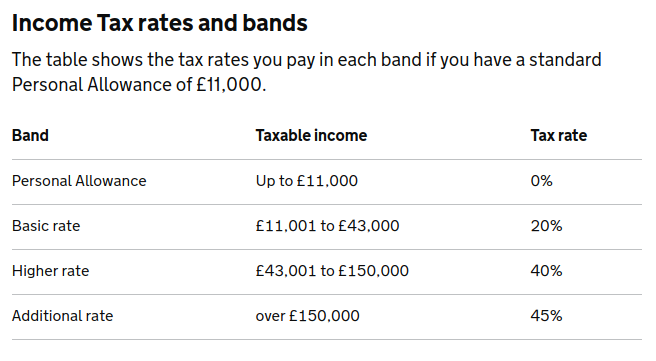
You can have a flat tax, so people pay in proportion to their income. 20% of a million pounds is more than 20% of ten thousand pounds. But that’s not what countries normally do. Normally they have what’s called a progressive tax. A progressive income tax is one where people with higher incomes pay a higher proportion of their incomes. The income tax in the UK is a progressive tax. Here are the rates:

UK Income Tax bands.png

You don’t pay any tax on the first £11,000 of yearly income, and then you pay 20% of the next £32,000, 40% of the next £107,000, and 45% of anything after that. People with higher incomes are paying higher rates. People making under £11,000 aren’t paying any income tax at all.

A progressive income tax has the “rich people pay more” effect to a greater extent than a flat tax does, and so leftwing people tend to like progressive taxes. Leftwing people these days also often call themselves “progressives”. As far as I know, this is a coincidence.

Now, as well as a flat tax or a progressive tax, there’s also the theoretical option of a regressive tax. You could just reverse the numbers in the table above: people pay 45% of the first £11,000, 40% of the next £32,000, 20% of the next £107,000, and nothing on income after that. Rich people are still paying more, just to a lesser extent. (Well, very rich people are all paying the same if the top rate is 0%. But very poor people are all paying the same, i.e. nothing, under the existing set-up. It still counts as rich people paying more than poor people.)

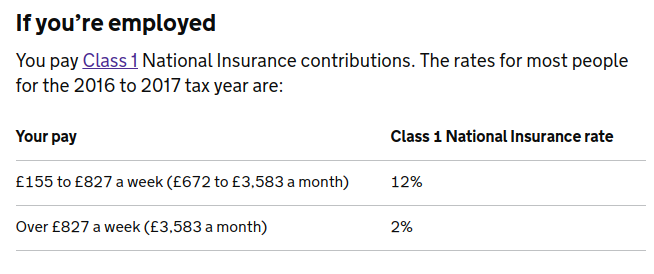
A regressive tax would probably be pretty unpopular. People would think it wasn’t fair, and to raise enough money to run the government you’d have to collect a lot of money from poor people, with inevitable damage to their quality of life. So it might surprise you to hear that the UK - the very same country that has the rather progressive income tax we talked about earlier - also has a very regressive tax. It’s called National Insurance. It doesn’t have the word “tax” in its name, but it’s still a tax. Here are the rates for employed people:
National Insurance marginal rates.png

Eagle-eyed readers will have noticed that £155 a week is a lot less than £11,000 a year, so while the poorest workers aren’t paying any income tax, they’re still paying plenty of national insurance. £827 a week does also put you more or less on the cusp of the basic and higher rates of income tax, which I suppose counts for something. But the fact remains that the UK has a progressive income tax which politicians and journalists talk about a lot, but makes up for it with a regressive tax that they hardly talk about at all. I don’t know if other countries do this, but it certainly seems odd. It’s hard to see what ideology a government could have which would motivate levying both taxes.

Before the 2015 general election, David Cameron said he had raised the personal income tax allowance a lot. “That is three million people taken out of income tax altogether”, he said. And I suppose that technically it was, but they were still paying plenty of tax on their income and their marginal rate was still 12%. So what Cameron said was a little bit misleading.

I think it’s very likely that the reason we have a progressive income tax and a regressive employment-income tax to make up for it is because the government and the electorate don’t agree on how progressively they want income to be taxed, and so the government divides the tax into two and mostly talks about the one that sounds less nakedly plutocratic. Maybe that’s not why they do it, but I’d at least like an explanation.


Saturday, April 2, 2016

I really don't understand the oil industry

When I was at school, between 1988 and 2002, they used to teach us that the world had about 30 years of oil left. It didn’t matter that the geography textbooks were ten or fifteen years old, because the thirty year estimate stayed pretty constant from one decade to the next. As I understand it, these estimates were based on how long it would take to use up currently proven reserves if current trends in usage stayed constant. Since more reserves got proven all the time, the time limit didn’t necessarily go down as oil got used up. The cynic in me suspects they deliberately went for a methodology that produced an alarmingly low figure because they wanted us to become enthusiastic about renewable energy. Perhaps it worked, although when you think about it the low figure is as much a reason to drill more holes in Alaska looking for oil as to make solar panels more efficient.


Regardless of where the figure came from and why it was pushed on children, the point was definitely that one day this stuff is going to run out. And nowadays we don’t think that’s true. If we burn all the oil we know about, then either we’ll need carbon capture technologies we don’t have yet, or climate change will make life as we know it impossible. We won’t let that happen, will we? Call me a wild-eyed optimist, but I don’t think we will. The key constraint on how much oil we’ll use is not how much of it there is. It’s how much we can use without ruining the climate.


Now, you might think this would have big economic consequences for the oil industry, and so it will. But we’re not seeing all the consequences you might naively expect. People are still looking for more oil, even though we don’t need any more oil. And you might expect that we wouldn’t bother getting oil from hard-to-get-at places anymore. There’s no point extracting oil expensively from Canada when there’s stuff just under the surface in Kuwait that’ll be left in the ground for the sake of the climate. (And it’s much more expensive to extract oil from Canada than from Kuwait. Like, more than four times as expensive.) If the international oil industry was centrally planned, the plan would be to use up the stuff that’s easiest to get at and leave the stuff that’s hard to get at in the ground. We certainly wouldn’t be blowing our carbon budget on shale gas that can’t be extracted without causing earthquakes in Oklahoma. Of course the international oil industry isn’t centrally planned, but market forces are supposed to be even more efficient than central planning, so they should be able to do at least as well as a central plan would. But they’re not. I don’t get it.


The good news is that something along these lines may finally be starting to happen. Apparently it’s surprising that oil prices are low and Saudi Arabia hasn’t slowed down its production, and Ben Walsh in the Huffington Post thinks it might be because they’d rather sell it now for $30 a barrel than leave it in the ground and then find that in fifteen years everyone’s got their own solar panels. What I don’t really get is that the tone of the article is more “hey, maybe this is what’s happening”, rather than “finally, this obviously massively overdue thing is happening”. I can only conclude that it isn’t actually overdue, and my whole understanding of the situation is wrongheaded. If you do understand it, enlighten me in the comments!

Sunday, November 9, 2014

Bubbles might not always be silly


I’ve been listening to NPR’s Planet Money podcasts recently, and a couple of days ago I listened to this one about economic bubbles. Bubbles are what some people call it when the price of something goes up and up and then crashes, and often you could kind of see that a crash was coming sooner or later. Sometimes people say that people were silly to spend all the money buying the thing when it was expensive. The podcasters spoke to Nobel Prizewinner Robert Schiller, who thinks the people driving up the price were being silly, at least sometimes. They also spoke to Eugene Fama, who shared the prize, and thinks that people aren’t being silly; you just can’t tell when something’s a bubble and when it isn’t. It was all pretty good-natured. Schiller and Fama shared their prize with another guy called Lars Peter Hansen, if you’re interested.

Now, regular readers will probably have noticed that one of my hobbies is duplicating the intellectual efforts of other people, and today is no exception. I had a bit of a think about bubbles. Silliness is hard to model, so I tried to think of a kind of situation where the price of something might go up and up and then crash, even though the investors are going into it pretty much with their eyes open.

Here’s what I came up with. You have some kind of commodity which is generating a pretty good income at the moment, but you don’t know how long it’s going to carry on doing it. Maybe it’s a tulip farm and at the moment people are paying top dollar for tulips, but you don’t know how long the craze is going to last. Maybe it’s a share in Justin Bieber’s record company. How do you value something like that?

Well, you need to quantify how long you think it’s going to last. Maybe you think it’ll last something between one and ten years, and your credences are distributed equally over one year, two years and so on up to ten years. That lets you put an expected value on it. Now, if you’re a Bayesian and it’s still popular after a year, you’ll think it has between one and nine years left, and your credences will be equally distributed over one year left, two years left, and so on up to nine years. This lets you put a new expected value on it, and it’ll be lower than it was a year ago. So the expected value of Bieber's tulip farm goes gradually down, until sometime during this decade people lose interest in his tulips and the value of the farm crashes. That’s not a bubble. In a bubble the price is meant to go up until the crash.

Suppose you model your uncertainty about how long the craze will last differently. Instead of thinking how long it’ll last, you think about what the craze’s half-life is. Maybe you think it’s got a half-life of between one and five years, and you distribute your credences equally over half-lives of one year, two years, and so on up to five. (The craze’s half-life is the length of time in which it has a 50% chance of ending. In general, if the half-life is h years, the chance of the craze surviving the next h*n years is 0.5n.)

Now what happens if the craze is still going after a year? Well, that was more likely to happen if the half-life was long, so you end up redistributing your credences to make a long half-life more likely and a short half-life less likely. This means that after a year the value will go up. And it’ll keep going up until the craze ends. That’s got the rise-rise-crash character of a bubble, but nobody has had to do anything silly. This is true even though it’s predictable that the price will rise until the crash, and even if the investors are all sure the crash is coming sooner or later. I guess that if prices going up and up and then crashing was always this kind of phenomenon, that would mean Fama was right and Schiller was wrong. But I don’t really know; I just listened to one Planet Money podcast. (Well, actually I’ve listened to about a hundred Planet Money podcasts, but only one was about bubbles.)

Is this a reasonable way of dealing with uncertainty about how long a craze will last? Sometimes, it probably is. People have been into Barbie dolls for longer than they’ve been into Loom bands, and this inspires confidence that Barbie will still be around after Loom bands are gone. The longer Loom bands stick around, the longer they might seem to have left. When something’s been around as long as Barbie and Coke, it’s hard to imagine it ever going out of fashion.

So here’s another question: do real commodities exhibiting the price-rise-then-crash phenomenon fit this model? Well, no. Not exactly. The dotcom bubble was based on a load of companies which often weren’t bringing in much income at all at the time (right?), with investors betting on future income. But I think that can still fit into the model. Even if you only projected that the income would come, say, five years into the craze, the expected value still goes up as the probable half-life goes up, and the probable half-life carries on going up until the craze ends (or until a bunch of similar crazes end). So maybe the dotcom bubble was like that too. And the tulip bubble. Anyway, I recommend the podcasts.

Saturday, October 25, 2014

Piketty and Paul


Regular readers will know that I’m pretty leftwing, but that doesn’t mean I’m blind to the fact that people respond to financial incentives. Sometimes people on the left get viewed as thinking we should act as if financial incentives didn’t really affect people’s behaviour much, and if this idealization results in a bit of inefficiency then you just have to suck it up. At the extreme that sort of thing might lead to something like communism, but maybe some lefties who aren’t communists are guilty of the idealize-and-suck-it-up mindset too. But I try not to be.


Given this, I think it’s a bit of a shame that we pay people to be unemployed, even though we don’t want people to be unemployed, and we charge people for earning money, even though we want people to earn money. (In case you can’t tell, I’m talking about unemployment benefits and income taxes.) The thinking behind these prima facie wacky policies is that if you don’t pay people to be unemployed then the unemployed will starve, and if you don’t charge people for earning money then you won’t be able to raise enough money to run the government. In the past I’ve expressed an interest in the idea of replacing unemployment benefits with a universal basic income that you give to employed people as well as unemployed people. But what about income tax? Is there a better way to raise money?


First let’s remind ourselves why income tax is such a shame. Suppose I’m rich and I’d rather have Lancelot Capability Brown landscape my garden than have £100,000, and Brown would rather have £80,000 than not landscape my garden. In an ideal world, I’d pay him somewhere from £80k-£100k to landscape my garden: it's a win-win situation. But if there are income taxes, the state will probably charge us so much to make this transaction that it isn’t worth either of our while to make it. I don’t get my garden landscaped, Brown doesn’t get his money, and the state doesn’t get anything out of it either. That’s no good. And everyone knows it’s no good, but we can’t think of a better system, so like the hypothetical lefties I mentioned earlier, we just suck it up. Where income taxes apply, people don’t just work when they value their time and labour a bit less than the employer does; the employee has to value it a lot less, so they'll still both be happy with the deal once the income tax is factored in.

What’s the alternative? Well, on the face of it, maybe it’s wealth taxes. If the wealth’s going to get taxed at the end of the year whether I have it or Brown has it, then transferring it to him doesn’t cost anything, and the inefficiency goes away. If I value his time and labour more than he does, we do the deal. I don’t know whether libertarians like wealth taxes – they sometimes seem to talk about sales taxes as better than income taxes, which I don’t really get – but I think there’s a case that they should. Libertarians don’t like the state charging people to engage in harmless activities, and that includes employment. With a wealth tax, the state’s taking some of your money anyway, but for the money you’re allowed to keep, you’re equally allowed to give it away. I’m not a libertarian, but I like freedom as much as the next person, so this seems like a nice feature. There’s also a case that libertarians shouldn't even see wealth taxes as a necessary injustice, because the state is the body enforcing continued property rights over people’s wealth and so it’s only fair for it to take a cut. (I sometimes wonder what would happen if big countries insisted that tax havens bear the burden of enforcing the property rights and contracts officially under their jurisdiction. Maybe Luxembourgish police officers would have to travel the world chasing up second-hand books people bought on Amazon and never received.)


So what’s the problem? Why are modern democracies nuts for income tax, while often having no wealth taxes at all? (Unless you count inheritance tax, which is a bit like a crude wealth tax.) Maybe it’s because they wouldn’t work the way I’m imagining, which is perfectly possible; my understanding of this stuff is pretty basic. Or maybe it’s because wealth taxes would hit the wealthy more than income taxes do, and so they use their wealth to stop it happening. Or maybe it’s because income tax is the only one people can’t rampantly avoid. I remember when Thomas Piketty’s book came out and he was pushing wealth taxes, he thought they’d need a lot of multilateral co-operation, and maybe he was thinking about avoidance. If that’s all it is, though, it seems a real shame, and economic libertarians are arguably the people who should be most bothered by it. Maybe if Rand Paul becomes US president then something will be done.

Wednesday, May 8, 2013

Risky business


I don’t know how many of the millions of people who’ve bought Daniel Kahneman’s Thinking, Fast and Slow have read it, but I have and I thought it was very interesting. One of things he talks about in chapters 25-26 is risk aversion. Lots of people won’t take a bet to either gain $200 or lose $100 on a coin-toss, and that seems to mean they’re risk averse. They stand to gain more than they stand to lose, and the chances are equal, but they won’t take that chance. Regular readers may remember risk aversion coming up once before when I was talking about Deal or No Deal.

Kahneman says that for a long time economists used to think that (or at least idealize that) people were risk averse when it came to money, but not when it came to utility. Your first million makes a bigger difference to you than your second, and maybe it even makes a bigger difference than your second and third put together. In view of that, maybe your last $100 makes more of a difference than your next $200. If that’s right, you’re not rejecting the bet by being risk averse; you’ve just got a proper appreciation of the diminishing marginal utility of money.

The problem with this line of thought is that while it can rationalize bets which seem sensible instances of monetary risk aversion, it can only do so by attributing people utility functions which also rationalize insane-seeming pieces of (monetary) risk aversion. Matthew Rabin showed this in a technical paper, and he and Richard Thaler wrote an entertaining paper about it which references Monty Python’s dead parrot sketch. The idea is that if diminishing marginal value of money is all that is going on, then someone can’t rationally reject one fairly unattractive bet without rejecting another very attractive bet. Their first example is that if someone will always turn down a 50-50 shot at gaining $11 or losing $10, then there’s no amount of money they could stand to win which would induce them to take a 50% risk of losing $100. They have several other examples, including ones which remove the ‘always’ caveat, only demanding that they would still turn down the first bet even if they were quite a bit richer than they are now. The basic idea is the utility of money has to tail off surprisingly quickly to rationalize rejecting the small bet, and if it tails off too quickly you'll have to make odd decisions when the stakes are high. They’ve thought of objections and the reasoning is hard (for me) to argue with.

Now, what Thaler and Rabin reckon is going on is loss aversion. The reason you won’t take the $100-$200 bet is that you recoil in horror at the thought of losing $100. There’s plenty of behavioural economics research (I’m told) showing that people can’t stand losing even if they’re pretty chilled about not gaining, and that’s why Thaler, Rabin and Kahneman think that’s what’s going on. Thaler and Rabin say it’s not just loss aversion either, it’s myopic loss aversion. The reason it’s myopic is that you’d take a bunch of $100-$200 bets if you were offered them at the same time, because overall you’d probably win big and almost certainly wouldn’t lose. But if that’s your strategy then you should take the bets when they arise, and in the long run you’ll probably end up on top.

I agree that people are myopic, and they don’t always see individual decisions as part of a longterm strategy where losses today get offset by the same strategy’s gains tomorrow. I think Thaler and Rabin have missed something when they invoke loss aversion, though. This is because you can set up the “if you reject this bet then you’ve got to reject this attractive bet” argument without doing anything with losses. Suppose I offer people a choice of either $10 or a 50-50 shot at $21. Sure, some people will gamble, but aren’t lots of people going to take the $10? If they haven’t already, some behavioural economists should do that experiment, because if people reject the bet then Rabin’s theorem will kick in just the same as before and lead to crazy consequences. The difference is that this time you can’t explain the difference as recoiling in horror at the prospect of losing $10, because the gamble doesn’t involve losing any money. It just involves not winning some money, and people are relatively OK with that. (Notice that choosing not to gamble also involves not winning some money.) If you object that the non-gamblers want to make sure they get something, then change the set-up (if your budget stretches that far) to either $20 guaranteed or a 50-50 gamble for $10 or $31. It still works, and I bet plenty of people will still take the $20.

Now, what I think is going on is myopic risk aversion. I don’t see that there’s much wrong with risk aversion in itself. If you could choose either a life containing a million hedons or a 50-50 shot at either a thousand or two million, I’d understand if you took the million. Only a real daredevil would gamble. And when John Rawls is putting whole-life choices before people in the Original Position, he won’t assume they’re anything less than maximally risk averse. Maybe Rawls has gone too far the other way, but I’d definitely want to see a pretty good argument before believing that the cavalier attitude of the expected-something maximizer is rationally obligatory.

Now, mostly when we make decisions they’re small enough and numerous enough that a fairly cavalier strategy has a very low risk of working out badly overall. Applying original-position thinking to the minor bets offered by the behavioural economists in the pub is confused. It feels like you’ve got a 50% chance of getting the bad outcome, but seen in the context of a more general gambling habit the chances of the bad outcomes are actually very small even with the cavalier strategy, and since its potential payoffs are much higher, you’d have to be very risk averse overall to turn down the gamble. You’re very unlikely to be that risk averse all things considered, although perhaps Rawls was right that it’s cheeky to make assumptions.

So that’s what I think’s going on. Loss aversion is real, but it can’t do the work Thaler and Rabin want, either in straightforward form or myopic form. I think the real culprit is myopic risk aversion. Overall risk aversion is rationally permissible, but myopia isn’t and can result in individual decisions looking more risky than they really are. Unless the stakes are really high, like on Deal or No Deal.