Pages

Showing posts with label knowledge. Show all posts

Friday, September 8, 2017

Reviewing Non-Fiction Is Hard

Sometimes I read non-fiction books, and really enjoy them. “What an awesome book,” I’ll think. But it’s actually quite hard to tell if non-fiction books are any good or not. At least, it’s hard to tell just by reading them. I guess you could read a review. But someone has to write the reviews.


The reason it’s hard is that you’ll usually be in one of two situations. Either you’ll be an expert in the topic the book is about, or you won’t be. Suppose you’re not, and so a lot of the stuff in the book is new to you. You don’t know if the book is any good or not, because you don’t know whether the stuff in the book is right or not. You can try factchecking it, but even if you can track down the sources they’ll often be buried in difficult academic writing of a sort you’re not really competent to understand. And if the book you’re reading is any good, a lot of what it’s telling you won’t be checkable facts, but rather a kind of expert insight and analysis that you wouldn’t be able to reconstruct yourself. And of course some books contain original research, in which case they can’t really be checked because in a way they are the source. These three all blur into each other, but they all make it very hard for a non-expert to tell if a non-fiction book is any good just by reading it. (And if we’re being strict about “just by reading it”, you’re not allowed to factcheck it anyway! But let’s not be strict. It's hard in any case.)


A good example of this danger is Daniel Kahneman’s Thinking, Fast and Slow. Kahneman is one of the world’s top psychologists, he did pioneering work on cognitive biases with Amos Tversky, and he won the economics Nobel "for having integrated insights from psychological research into economic science, especially concerning human judgment and decision-making under uncertainty". The book is about cognitive biases and decision-making under uncertainty, and the title refers to two styles of thought, one automatic and not very conscious and the other fairly carefully thought through and more conscious. It tells you about lots of cool little findings from psychological research, like how people are more likely to believe something they read if it’s written more legibly (pp62-3), and it integrates the anecdotes into a general narrative about the different ways people think.


When that book came out, it was very well received by people who weren’t already experts on the topic. I vaguely remember experts being more divided on it, but I’m not an expert and I thought it was awesome. I was entertained by the anecdotes, and I really felt like I was learning something. I told my friends the anecdotes as if we could be confident that they were true, and I recommended the book to them. But since it came out, psychology has had a bit of an existential crisis based on the fact that lots of its little findings don’t replicate. A lot of effects people found may well have been flukes that only seemed representative of how people behave because when psychologists have done experiments and not found anything cool they haven’t told anyone about them. Or they have but nobody has listened, which makes them less likely to bother telling people next time. Kahneman himself is very concerned about the whole thing, and he thinks he was a bit too credulous about some of the stuff in the book.


Now, I don’t want to set Kahneman up as some kind of fall-guy here. It may still be a good book, and the issues with some of the anecdotes may be kind of minor. He’s still a great psychologist and communicator, he was writing in good faith, and his willingness to publicly address problems with his own work is impressive and an example to his colleagues. The point is that I wasn’t competent to judge how good his book was. And to be honest, I still couldn’t tell you.


So, it’s hard to tell if a non-fiction book is good if you’re not already very familiar with the subject. Well, duh! But what if you are an expert? What if you could have written the book yourself? In that case you have a different problem: The Curse Of Knowledge. In his book The Sense of Style, Steven Pinker argues that the reason people often write badly is they struggle to imagine what it’s like not to know things that they in fact do know. You know what you want to say, but your reader has to try to work it out from what you’ve written, and it’s hard to put yourself into their mind and work out whether what you’ve written would still be clear. And if you’re trying to explain something you already understand but they don’t, you have to put yourself into their mind and work out whether they can understand the thing you’re trying to explain on the basis of what you’ve written. That’s hard too. Now, imagine you’re an expert reading a book by another expert on the same thing, and you’re trying to work out whether a non-expert will be able to understand the thing the book is about on the basis of what the book says. It’s not easy to do.


So, who should be reviewing books, if both experts and novices face systematic obstacles? Three suggestions come to mind.
  • Someone who is neither an expert nor a novice. What you want is someone who doesn’t already know what the book says, and so doesn’t have the curse of knowledge, but who’s competent enough in the sort of thing the book is about to be able to check if it’s right, once they’ve been told the things the book says. In general it’s often easier to check an answer to a question than find the answer. While I wasn’t competent to check if Kahneman’s book was any good, maybe a psychologist in a different field could have done it.
  • A great teacher. The curse of knowledge essentially arises because a certain kind of imaginative exercise is difficult. But some people seem to be quite good at it. Being good at it is part of the skillset of a great teacher: they need to be able to get into the minds of the students and tell whether what they’re saying would communicate the material to someone who wasn’t already familiar with it.
  • A novice and an expert working together. The two problems are pretty separate, so in theory the expert ought to be able to read the book to check that what it says is sound, while the novice reads it to see if they feel like they’re learning something. And after they’ve both read it, the novice and the expert can talk to each other so the expert can check that the novice really did learn the things they felt like they were learning.

My favourite one is the last one. While an expert in an adjacent field might be able to do a decent job of factchecking, they won’t do as good a job as an expert, and it’ll be harder for them. Their transferable research skills will also mean they still have to do a bit of difficult imagining to get into the minds of the intended audience. A great teacher might be able to do the job, but we don’t even have enough great teachers to fill all the teaching jobs, let alone all the reviewing jobs as well. This leaves the last option. Unlike great teachers, experts are ten a penny, and novices are twenty a penny. Of course, you do need two people. But it’s still my favourite option, and it’s kind of odd that it practically never happens.

Monday, July 18, 2016

Cocksure certainties

I was reading an opinion piece in the Observer by Nick Cohen yesterday, and I came across this paragraph:


As the opposition collapsed last week, Paul Mason insisted that Labour must be transformed from a party that seeks to govern into a “social movement”. Mason, along with Michael Gove, Boris Johnson and Milne, is part of a group of journalists who have poisoned public life by taking braggart swagger and cocksure certainties of newspaper punditry into politics. But in this instance, he was authentically reflecting “the people” or, rather, that tiny section of “the people” who pay £3 and click on a link to show they agree with him.


My first thought was that it was strange for a political newspaper pundit to talk about political newspaper punditry in such uncharitable terms. It might be fair enough for a reality TV star to criticize Donald Trump for poisoning public life by taking the cartoonish offensiveness and fakery of reality TV into politics, but this seems different. Political newspaper punditry seems too similar to public life for braggart swagger and cocksure certainties to be OK in one but not in the other. Perhaps you’ll disagree with me about that. But there’s something else I wanted to pick up on in the paragraph. It’s the cocksure certainty expressed with such braggart swagger in the last sentence. I think it might not be quite accurate.


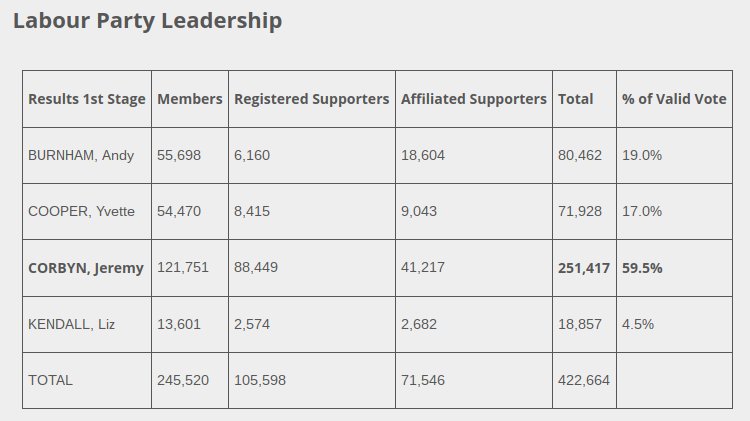
Corbyn labour leadership results.jpg


You’ll notice that Corbyn did much better than any of the other candidates among members, and among registered supporters, and among affiliated supporters. From what Cohen said, you’d think that Corbyn won the election because of the votes of the people who had paid £3 to be able to vote in the leadership election. Those people are the “registered supporters” column. But if Corbyn is winning in all the columns, then what Cohen said is quite misleading. Unless I’ve misread something.


I don’t know if he really thinks Corbyn won the election on the back of the £3 voters. It seems a weird thing for him to be wrong about. But since people are discussing Corbyn’s leadership a lot at the moment, it’s worth getting this right. When Corbyn was elected, the big split wasn’t between the party and the clicktivists. It was between the party membership, the clicktivists and the members of affiliated organizations on the one hand, and the Labour MPs on the other. Maybe the split is in a different place now, but that’s where it was last year.

Now, I understand that Nick Cohen thinks that the platform that most Labour MPs want the Labour party to present is closer to the views of the electorate as a whole than Corbyn's platform is. That's a genuine concern. But it's very different from the idea that Labour's leadership is out of touch because the election was hijacked by a group of fairweather enthusiasts with £3 to spare. If Labour is out of touch with the people, then it's out of touch at every level but the MPs. (The MPs may of course be out of touch as well. We don't really know a great deal about the people's view on Angela Eagle, Owen Smith, or whoever the Parliamentary Labour Party wants to replace Corbyn with.)

***************************

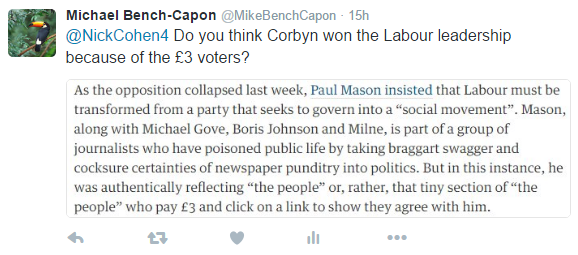
I did try asking him on Twitter whether he thinks that Corbyn only won because of the £3 voters, but he didn’t reply. That’s completely understandable: he’s famous and I’m sure people tweet at him all the time. Here’s the tweet:


Tweet to Nick Cohen about Corbyn and £3 voters.png


Wednesday, July 2, 2014

Obviously


Back when I was a long-haired fresher, I was taught logic from a book by Wilfrid Hodges called Logic. I’ve since lent the book to someone from whom I don’t expect to get it back, but if I remember correctly, at the end the author wonders what expressions might one day have a logic developed for them. He wonders about ‘obviously’. He says he thinks that P follows from Obviously P, and that it’s unclear whether or not Obviously obviously P follows from Obviously P. I don’t remember him saying so in the book, but these principles correspond to the modal axioms T and S4. The S5 axiom would say that Obviously it’s not obvious that P follows from it’s not obvious that P, though I don’t think he mentioned that one at all.

I don’t have a logic for ‘obviously’.

I do however have an idea for an analysis of ‘obviously’, which I’ll tell you about now. I think that the fundamental facts about obviousness – or at least as fundamental as you can get while still using the concept of obviousness – are facts about what is obvious to a person. Facts of the form P is obvious to S. My first pass at an analysis of that is this:

If S considered whether or not P, S would be disposed to know that P.

This will admit some false positives, such as it usually being obvious to everyone that they are considering something, even when they’re not. We can patch that up easily enough:

P, and if S considered whether or not P, S would be disposed to know that P.

I expect that that’s still going to have some false positives like someone is considering something, and probably false negatives like S isn’t considering anything. (If not that one, then others.) This is the same kind of problem you get with counterfactual analyses of anything, but that needn’t make them useless. I’d hope you could deal with the false negatives by being careful about what you held fixed, perhaps making it a counterpossible conditional if necessary. And I’d quite like to deal with the false positives by saying something like this:

There’s a fact F that P, and if S considered whether or not P, S would be disposed to know F.

The idea is that for each G thing there is a different fact that there are G things, and if considering whether or not there were G things would create another G thing, that’d be another fact, and knowing that wouldn’t mean you knew one of the pre-existing facts. That involves a weird and unexplored (by me) ontology of facts though, so I’ll just hitch my wagon to those of the people already working on the false positives problem for counterfactual analyses.

False positives and negatives aside, I think the basic idea is pretty good. It allows that a priori facts can be obvious, which they can, without making them all obvious, which they’re not. It allows different things to be obvious to different people, which they are. It also allows people to miss obvious things, which they do, and it holds that this will usually but not always be things they haven’t considered, which also seems right to me. When you say that something is obvious simpliciter, your intentions or the context will supply some actual or hypothetical person or people (and an actual or hypothetical situation for them to be in) to relativize it to. This will also go for the sentential adverb obviously, except when you’re using it as a meaningless filler. (Not that there’s anything wrong with that.)

The T axiom obviously follows this analysis. I don’t think it decides the other modal axioms one way or the other, although I haven’t thought very hard about it. I suppose it could help us make some progress on the other axioms though, because it’d mean they had some consequences for knowledge or dispositions, which you might already have views on. Progress!

Sunday, March 13, 2011

Some analytic philosophy

I’m one of those throwbacks who think the analytic-synthetic distinction is probably bunk. (Analytic statements are ones where you can tell they’re true just by understanding them and reasoning; synthetic statements are the other ones.) Quine came up with some arguments against the distinction, and the following sixty years of posterity seem to have judged it more interesting than the other thing he identified as a dogma of empiricism. I think Quine was more or less on the money, but I have a job convincing people that things like ‘vixens are female foxes’ aren’t analytic, even if they agree that Quine showed the distinction not to be quite the big deal that his more dogmatic empiricist predecessors had thought it was. Bad as I am at persuading people of it, I thought I’d have a go here. I doubt this is new, but it’s the sort of thing I worry about when I’m worrying about the distinction.

Here are a few sentences which you might have a view on:
1.      ‘The vixens are all and only the female foxes’ (analytic)
2.      ‘Superman is Superman’ (analytic)
3.      ‘Clark Kent is Superman’ (not analytic)
4.      ‘Water is H2O’ (not analytic)
5.      ‘Gorse is furze’ (?)
6.      ‘The women are all and only the female adult humans’ (analytic)
7.      ‘The ladies are all and only the female adult humans’ (analytic)
8.      ‘Women are ladies’ (?)

(1) is meant to be a paradigm case, and (6) and (7) aren’t relevantly different from it. The difference between (2) and (3) is meant to bring out the difference between informative and uninformative identities which Frege and I have spent time fretting about. (4) is meant to be like (3) but with a natural kind instead of a superhero. (5) is meant to demand the same verdict as (4) but be more similar to (8). (If you’re not persuaded that (5) isn’t analytic but you like Putnam, then consider what he said about beeches and elms.) But if (6) and (7) entail (8), (8) should be analytic too.

What’s happened? Obviously I think that what’s happened is the distinction’s bunk. I’m not sure what the proper response for my opponents is. I think one thing they’ll say is that the concepts woman and lady are both parasitic on the same concept human. But if that’s true, then I don’t see that there are two distinct concepts in the gorse/furze case either: just one concept that you could acquire twice without realising it. So we’ll have to say that ‘gorse is furze’ is analytic, but if we say that, we can’t use analyticity to explain why it’s informative and ‘gorse is gorse’ isn’t. While you’re here, try these:
9.      ‘The women are all and only the female adult homo sapiens’ (?)
10.  ‘Female adult humans are female adult homo sapiens’ (?)
11.  ‘Humans are in the genus homo’ (not analytic)
12.  ‘Homo sapiens are in the genus homo’ (analytic)

(10) follows from (6) and (9). I’d have thought (9) looked pretty analytic, but (10) shouldn’t be analytic if my verdicts on (11) and (12) are right. I’m not sure how persuasive any of this should be. I expect the thing to do is accuse me of equivocation here and there, but I don’t know how much mileage there would be in that, and in any case if 'H2O' and 'homo sapiens' are ambiguous then that's interesting in itself. If I've done something straightforwardly foolish I've also got a thought-experiment about an invasion of bachelors, but I won't get into that here.

Essentially I’m trying to drive a wedge between saying that true identity statements with rigid designators on both sides are ever synthetic, and saying paradigms like ‘vixens are female foxes’ are analytic. If you deny the paradigms you’ve conceded a lot, and if you deny synthetic identities you can’t use analyticity to explain why some identities are informative and some aren’t. If you’re not careful, analyticity won’t be able to explain why anything is a priori. A concept of analyticity as weak as that might be one I could get on board with.