Pages

Sunday, March 27, 2016

The Easter Bunny

Rabbits don’t lay eggs. Normally there would be no reason to point this out, but today is Easter, and one strand of Easter folklore has it that there’s a close connection between Easter eggs and the Easter Bunny. The Easter Bunny is a rabbit.* Now, it’s not clear whether the Easter Bunny actually produces the eggs itself or just hides them, the way Father Christmas has elves to make his toys while he focuses more on distribution. But even if the Easter Bunny delegates the manufacturing side of the operation, the eggs have to come from somewhere. Where do they come from? Not the Easter Bunny’s reproductive system, that’s for sure.


Many animals do lay eggs, principally birds and reptiles. I guess the reason we’ve settled on a rabbit rather than a bird or reptile is that reptiles aren’t cuddly enough and birds aren’t seen as having enough personality. But there’s one animal that is as cuddly and as spunky as a rabbit and also lays eggs. That animal is the duck-billed platypus.

Too spiky to cuddle? The western long-beaked echidna lays eggs too, but
its spikes make it an unlikely symbol of vernal good cheer.


The only explanation I can think of for our continued belief that Easter eggs come from the Easter Bunny rather than the Easter Platypus is that people have seen the Easter Bunny hiding the eggs, and it definitely wasn’t a platypus. It’s easy to tell them apart, after all, because of the bill. But this doesn’t rule out the hypothesis that the Easter Bunny hides eggs which are produced by a hardworking team of Easter Platypodes. And when you think about it, no other explanation really makes sense.


*Some people will tell you that the Easter Bunny is, or was, a hare. I find this implausible. Like Father Christmas, the Easter Bunny has a lot of work to do, and hares are notoriously lazy. In addition to the fable of the tortoise and the hare, we also have evidence from comparing the living arrangements of rabbits and hares. While rabbits put a lot of work into digging burrows and warrens, hares just find a slightly indented patch of ground and then kind of lounge around on it. They call this non-construction a form, but they’re basically just lying on the ground. Lazy. And hares don’t lay eggs either, so the point is moot to the present discussion anyway.

Tuesday, March 22, 2016

Bullshit, philosophy and regulatory capture

The Dunning-Kruger effect is great fun, because it gives you scientific respectability when you tell someone they’re so stupid they don’t even know they’re stupid. It’s a brave person who’ll double down in the face of such an accusation. Besides being fun, the effect is probably real, and it’s not really mysterious. The idea is that the ability to do something well often overlaps a lot with the ability to tell whether it’s done well. So people who are very bad at something will also often be bad at telling how good they are, and so will be prone to erroneously believing themselves to be experts. According to Wikipedia the effect was first tested by David Dunning and Justin Kruger in 1999, and as with so many simple ideas one wonders what took us so long. Perhaps skill in coming up with seemingly obvious ideas overlaps with skill in discerning in retrospect how obvious those ideas really were.


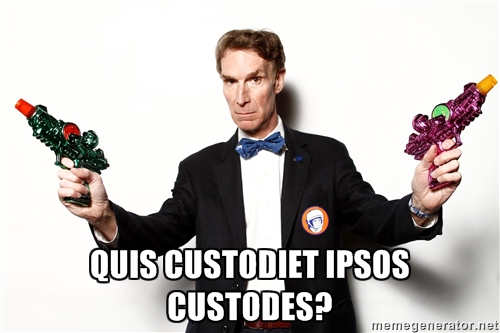
The Dunning-Kruger effect doesn’t apply to everything, of course. In some areas, ability to perform well doesn’t overlap much with ability to discern good performance. You don’t have to be able to run fast to use a stopwatch, and (to give a less clear cut example) great football managers were often fairly ordinary players. But one kind of area where the effect is very likely to arise is academia. One area of academia is philosophy. And people with no expertise in philosophy do love trash-talking philosophy. A particularly embarrassing recent case is Bill Nye the Science Guy.


Philosophy is probably a friendlier environment for bullshit than many other areas of academia, because it’s not very testable. Now, some of it is a bit testable. Karl Marx was a philosopher, and it’s probably fair to say that his ideas had undergone a lot more testing by the end of the 20th century than they had at the start, and that the history of the 20th century should inform the discussion of his ideas. Philosophical arguments that human cognitive faculties are located in the heart rather than the brain have been empirically refuted even more decisively. We probably have some empirical evidence that matter is composed of indivisible particles which wasn’t available when the ancient atomists first proposed the idea. But some philosophy seems not to be testable at all. David Chalmers is a philosopher, and he argues that philosophical zombies are possible, which means that there could have been creatures physically identical to humans but lacking any consciousness. How do you test that? Maybe you can. But it’s at least not obvious that we’ve gathered any empirical evidence that bears on the question at all. You don’t have to be a rocket scientist to see that rocket science helped put twelve men on the moon, and you don’t have to be a political philosopher to see that communism didn’t pan out quite the way some people expected. But the only way to assess whether the people talking about philosophical zombies are on to anything is to understand the methodology and the arguments, and once you’re at that point you’re already pretty good at doing philosophy yourself. You can’t tell if philosophy is a problem without becoming part of the problem.


Bill Nye Quis Custodiet Ipsos Custodes.jpg


One variant on the age-old “who watches the watchers” problem is called regulatory capture. Part of the problem is that it’s in an industry’s interests to gain control of whatever government body is charged with regulating it. But another part is just that competent regulators will be drawn from the same profession they’re regulating. They know each other, they like each other, they share assumptions, and these conflicts of interest can lead to the regulation not being done properly. It didn’t have to be this way. You could have parallel institutions which train and employ regulators, the way different countries train their armed forces largely independently, and the instituitions and personnel of law enforcement and organized crime are mostly separate. But it’s expensive, and it’s not usually what happens. Regulatory bodies hire people from the industries they regulate. And there just isn’t a group of people who have the expertise to call bullshit on philosophy but aren’t heavily associated with and invested in the discipline. Bill Nye isn’t competent to call out our bullshit, but the people who are competent aren’t impartial enough. The inevitable conclusion is that philosophy is doomed to raise sceptical eyebrows forever. It could all be bullshit and nobody would ever know.


But this conclusion is not inevitable. Philosophy does in fact take very seriously the idea that large parts of itself are bullshit, or meaningless, or obvious, or obviously false, or completely unimportant. One reason it does this is that it’s the sort of issue philosophers are interested in, another is that these kinds of critique sometimes follow from other philosophical positions, and a third plausible reason is that philosophy attracts disingenuously self-deprecating navel-gazers. If the watchers are self-involved enough they will watch each other, especially once they have tenure.

Another aspect of philosophy’s tendency to call bullshit on itself is less inspiring, however. It smacks of tribalism, the Dunning-Kruger effect, and a general Anglo-Saxon distrust of all things French. There’s a tendency for analytic philosophers, at least in English-speaking countries, to think that all that stuff that goes on in continental European philosophy departments is a load of garbage. But we’re not competent to judge. Maybe they hear us calling Derrida a charlatan and think “how do they know?”, but maybe they react to it the way we react to Bill Nye. And I think that if they reacted the second way they’d usually be absolutely right. We don’t know what we’re talking about. But they do, and I hope they’re self-involved enough to take the possibility that their whole field is a load of garbage seriously.

Saturday, March 12, 2016

Why Trump's opponents endorse him over Clinton

I’ve been following the US Presidential primaries fairly closely, partly because it’s important and partly because a lot of the coverage comes in the form of comedy monologues from late night shows I can watch on Youtube. I haven’t contributed much to the coverage myself, and up to now it’s been getting by fine without me. But now I think I may have thought of something new to say about it. I've seen some people wondering why Cruz, Kasich and Rubio still say they’ll endorse Trump if he wins the nomination, and I think I know the answer.


Here are four possible explanations which I don't think are right. First, they actually think Trump would be a better President than Hillary Clinton. It’s hard to get into the head of someone who thinks that, but these aren’t especially normal people we’re talking about, so maybe that’s what’s going on. A second possible reason is that they said they would support whoever was nominated. Politicians don’t like to be seen to break their promises, and maybe they don’t want to be seen to break this one, at least not while they’re still running for President. A third alternative is that they respect the democratic processes of their party. Cruz, Kasich and Rubio are all members of the Republican party, and might be presumed to have some party loyalty, and that includes loyalty to the primary voters. If the voters endorse Trump, they’ll endorse Trump out of loyalty to the voters. Fourth, they may be concerned that Republican primary voters think Trump would be a better President than Hillary Clinton. Lots of these people are actually voting for Trump, after all, and they made up their minds a long time ago that Clinton would be a terrible President. Maybe the candidates think that endorsing Clinton over Trump would turn voters off.


I don’t think any of these are especially implausible, but they’re not very clear-cut. You can imagine the candidates or their campaign strategists thinking quite hard about the decision, analysing polls and asking themselves fundamental questions about who they really are as politicians, and they could end up going either way. Three fairly different candidates in fairly different situations have all considered the question and all come up with the same answer: say they’ll endorse Trump if he wins. One exaplanation for the consensus is that the question is in fact a no-brainer. And I think it is.


Trump agreed he would endorse the eventual nominee and not run as a third-party candidate as long as the party was fair to him. Cruz, Kasich and Rubio all just pledged their loyalty without the fairness caveat. If Cruz says that actually he won’t endorse the eventual nominee if it’s Trump, and then Cruz wins the nomination, the agreement with Trump will clearly be broken, and not by Trump. Trump would be free to run as a third-party candidate, and why wouldn’t he? He’s rich, he’s having the time of his life, and he might even think he could win. So Trump runs, he and Cruz split the rightwing vote and Clinton wins in a landslide. In short, Cruz, Kasich and Rubio are sticking to their agreement because not doing so would doom any chance they have of winning the Presidency.

Of course, this reason for endorsing Trump over Clinton disappears when a candidate drops out of the race or if Trump actually wins the nomination. It’s unlikely he’s going to stop giving Republicans pretexts for saying that this time he’s gone too far and even Clinton would be better. It’ll be interesting to see if they’re still endorsing him in November.

Sunday, February 28, 2016

My picks for the 2016 Oscars

The Oscars are tonight. I’ve always quite liked the Oscars, in spite of all the reasons not to. This year I decided to guess the winners. Here are my picks:


Picture
Revenant
Director
Iñárritu
Actor
DiCaprio
Actress
Larson
Supporting Actress
Vikander
Supporting Actor
Stallone
Original Screenplay
Big Short
Adapted Screenplay
Spotlight
Score
Hateful Eight
Song
Til It Happens to You
Sound Editing
Mad Max
Sound Mixing
Revenant
Hair and Makeup
The 100 Year Old Man Who Climbed Out of a Window and Disappeared
Costume Design
Carol
Production Design
Martian
Cinematography
Revenant
Documentary Feature
Amy
Documentary Short
Chau
Live Action Short
Stutterer
Animated Short
Sanjay's Super Team
Animated Feature
Inside Out
Foreign Language
Mustang
Editing
Mad Max
Visual Effects
Mad Max


My methodology was to look at some other people’s picks, and go with the consensus. Where there were ties, I broke them in a few different ways. In the categories where hardly anyone will have seen the nominees, I went for the one rated by the most people on IMDB.com. I went for Mad Max over Star Wars in a couple of technical categories because I thought people might be a bit ashamed to vote for Star Wars. I went for Carol over The Danish Girl for costumes, and The Martian over Mad Max for production design, because Carol and The Martian went down pretty well and voters might want to make sure they got something, while Mad Max and The Danish Girl are probably winning in other categories. The only one where I overruled the professionals altogether was makeup, because I couldn’t think of a way of breaking the tie and I read somewhere that the 100 Year Old Man has pretty impressive old-person makeup. Also I really liked the book.

I’m looking forward to finding out how I did. If you think my picks are stupid, tell me why in the comments!  

Sunday, February 14, 2016

You cannot be Ceres

The biggest rock in the asteroid belt is called Ceres. It already has a couple of alien settlements on it, as you can see from the picture below. This probably won’t stop us colonizing it one day. It’s kind of a big deal as extraterrestrial objects go, but I don't know how to pronounce its name. Here are some suggestions. If you have any others, put them in the comments!
  1. Series
  2. Sear’s
  3. Cheers
  4. Cerys
  5. Caress
  6. SARS
  7. Sirs
  8. Chairs
  9. Cherries
  10. Serries
  11. Cares
  12. Churrs
  13. Curs
  14. Shares
  15. Cerise

Ceres.jpg

Saturday, January 23, 2016

How to link to things on Twitter

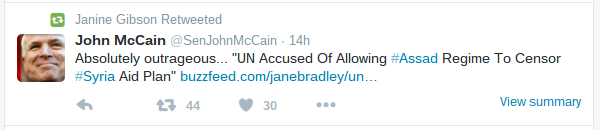
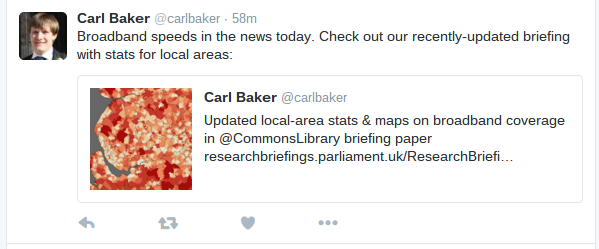
Twitter is fun. One of the fun things you can do on it is link to things you think people will like. Another is you can retweet things other people have tweeted. And nowadays when you retweet something you can add a little comment of your own. Without a comment it comes up on people’s feeds like this:

Retweet.png


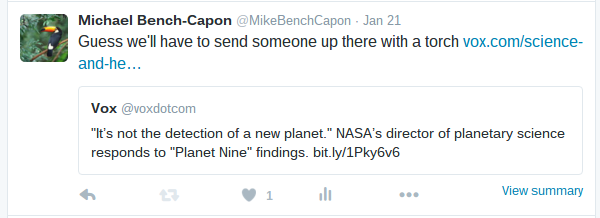
And with a comment, your followers see something like this:


Quoted tweet.png


Now, you may have noticed that what Janine and Carl have done is to combine the two fun things about Twitter that I mentioned earlier: they have retweeted things with links in them. But while Janine’s followers can click on the link to open it, Carl’s followers can’t. At least, not if they’re using Twitter on any of the devices I’ve ever used. You can’t click on a link in a quoted tweet! What you have to do, as far as I can tell, is click on the quoted tweet to open it up, either in a new tab or by leaving the main twitter feed page, and then click on the link. This involves a lot more clicking and mouse-moving, and if Richard Thaler and co have taught us anything it’s that making people do things like open new tabs will make them less likely to open a link. You want people to open the link, don’t you? Well, maybe sometimes you don’t. You might be quoting the tweet for some other reason. But if you do want people to open your link, you should repeat it in your comment, like this:


Quoted tweet - good.png

Got that? See the difference? When you quote a tweet with a link in it, repeat the link in your comment. Unless you don’t want people to click on the link. And it’s not just Carl I’m talking to; he was just the first example in my Twitter feed. I hardly ever see anyone else doing it right. Do it right! You’ll save your followers time, and the things you’re trying to make viral will be more likely to go viral.

Friday, September 18, 2015

Emotional Logic

A couple of weeks back I was reading a review of a book about rhetoric over at NDPR, like you do. It was called “The Philosophy of Argument and Audience Reception”, by Christopher W Tindale, and it was reviewed by Gary Curtis. The review was very negative. Here’s how it ended:


“To end on a positive note, the editing of this book is outstanding and a great relief after some prior unpleasant experiences with sloppily edited scholarly books. I have found only three typographical errors in the entire volume (pp. 55, 117n, 235), which may be some kind of record.”


The review did get me thinking a bit about the role of emotions in argument though, especially with this passage:


“Chapter 8 examines the important issue of the role of emotions in argumentation. As mentioned previously, this is a major difference between rhetorical argumentation and logic or dialectic. Tindale claims that emotions are rational (p. 160), but his support consists of pointing to the work of neurologists such as Antonio Damasio (1994) that appears to show that emotion is involved in practical decision-making. However, this does not support the conclusion that emotions are necessarily rational and, elsewhere in the same chapter, Tindale accepts that sometimes emotional argumentation can be fallacious (pp. 161-162). So, how can we tell whether a given appeal to emotion is fallacious? Tindale seems to accept as rational the appeal to hope in the speech that launched Barack Obama’s presidential campaign (p. 164) but labels fallacious an example from Benjamin Netanyahu that appears to have appealed to fear (p. 162). What makes the one emotional appeal rational and the other irrational? Is it the difference between hope and fear? Are not some appeals to fear rational and some hopes irrational? Unfortunately, the book supplies no answer.” (My emphasis)


When I read this I felt like Curtis was guilty of a kind of uncharitable interpretation. I’ve calmed down now, but I still think he’s been a bit cheeky. If you’re affecting to attempt to fill in the gaps in someone’s argument, you shouldn’t just make the first suggestion off the top of your head, no matter how weak it might be, only to shoot it down in the next sentence and move on. I think it would have been a better review if he had cut out “Is it the difference between hope and fear? Are not some appeals to fear rational and some hopes irrational?” And of course it would have improved the review even more if he’d been able to come up with a plausible suggestion.


I think it’s quite likely that the difference between good and bad argumentative appeals to emotion can be spelled out in a reasonably illuminating way. Rather than look for a difference between hope and fear, which Curtis and I both take to be a non-starter, you can look at the way the argument under discussion appeals to emotions. And if we’re already in the game of saying that emotions can be felt for good or bad reasons, and can rationally motivate actions, then it’s not too hard to see how that might go. Basically, if emotions can follow rationally from reasons, and things can follow rationally from them, then good emotional arguments can be the ones where the emotions appealed to really do follow rationally from the reasons the speaker uses to support them. Likewise, if the speaker justifies a claim or recommends an action on the basis of an emotion, then the argument is good only insofar as the claims or actions really do follow rationally from the emotion.


Netanyahu bomb.jpg


I don’t know which specific arguments Obama and Netanyahu were using, but using the idea from the previous paragraph the difference might be something like this. Netanyahu argues for some policy or other towards Iran on the basis of fear, and he tries to get the audience scared by lying to them about how close Iran is to building a nuclear bomb. That’s analogous to an unsound argument, because the premises supporting the fear aren’t true. Alternatively, he might have said some things that were true but don’t rationally elicit fear, for example pointing out that a lot of Iranians have beards, which is analogous to an invalid argument. Or maybe he argued soundly for the fear, but then used the fear to support actions that fear doesn’t rationally support. If Obama avoided all these things, telling the audience things which are true and are good reasons to hope, and if the hope rationally supported the things he was using it to support, then Obama’s appeals to hope are dialectically OK.


So, suppose we’re on board with this sort of thing and think that arguments appealing to emotion might be subject to rational appraisal in terms analogous to validity and soundness. Then we’ve got some work to do developing a logic of emotional argument. What could we expect it to look like? One thing to note is that the emotional parts of an argument can figure as premises, conclusions or lemmas, just like the propositions in a regular unemotional argument. As premise: you are speaking to someone who is already emotional and appeal to this to support a conclusion. As conclusion: your goal is to get someone emotional so you tell them things to (rationally, you’d hope) elicit the emotion. And as lemma: you say things to get people emotional and then start making policy recommendations. All of these seem pretty common in the wild, and all fit quite nicely into a framework based on the paradigm of arguments as chains of propositions, each of which either is believed already or follows from the ealier ones.


There are a couple of places I think emotional arguments might depart from the unemotional paradigm. First, there’s a fairly standard picture on which logical consistency and consequence are relations between propositions, and instances of them generate rules governing which beliefs shouldn’t be held simultaneously, which changes we should and shouldn’t make to our beliefs, and which bits of talking are good arguments. It’s clear enough what form the rules part will take when it comes to emotional logic, but it’s less clear what form the “relations between propositions” part will take. That’s because it isn’t clear what stands to an emotion the way a proposition stands to a belief or an assertion. So there’s a danger that rational norms governing emotions will be a bunch of superficially plausible rules built on nothing.


The second is more fun, if that’s possible. It doesn’t seem to me completely out there to say that emotions might sometimes be made rationally permissible in the light of the reasons for them, without being made obligatory. If that were the case, then using an emotional lemma might enable us to rationally draw a conclusion which didn’t follow from the premises by cold unemotional logic. Emotional lemmas could play an essential logical role in arguments, rather than just the pedagogical or rhetorical role that propositional lemmas play - you can’t accept the conclusion on the basis of the premises without going via the emotional lemma. And you have to really feel it. This looks like a violation of something like harmony or conceptual conservatism, but that’s why it’s so exciting. But perhaps reason is and ought to be the slave of the passions, and this whole emotional logic stuff is bunk.